 Book
Book7 min read
Thoughts on <DO HUMANKIND'S BEST DAYS LIE AHEAD>
amid these days so full of AI-driven FOMO, to consider what kind of future for humankind we ourselves hope for.
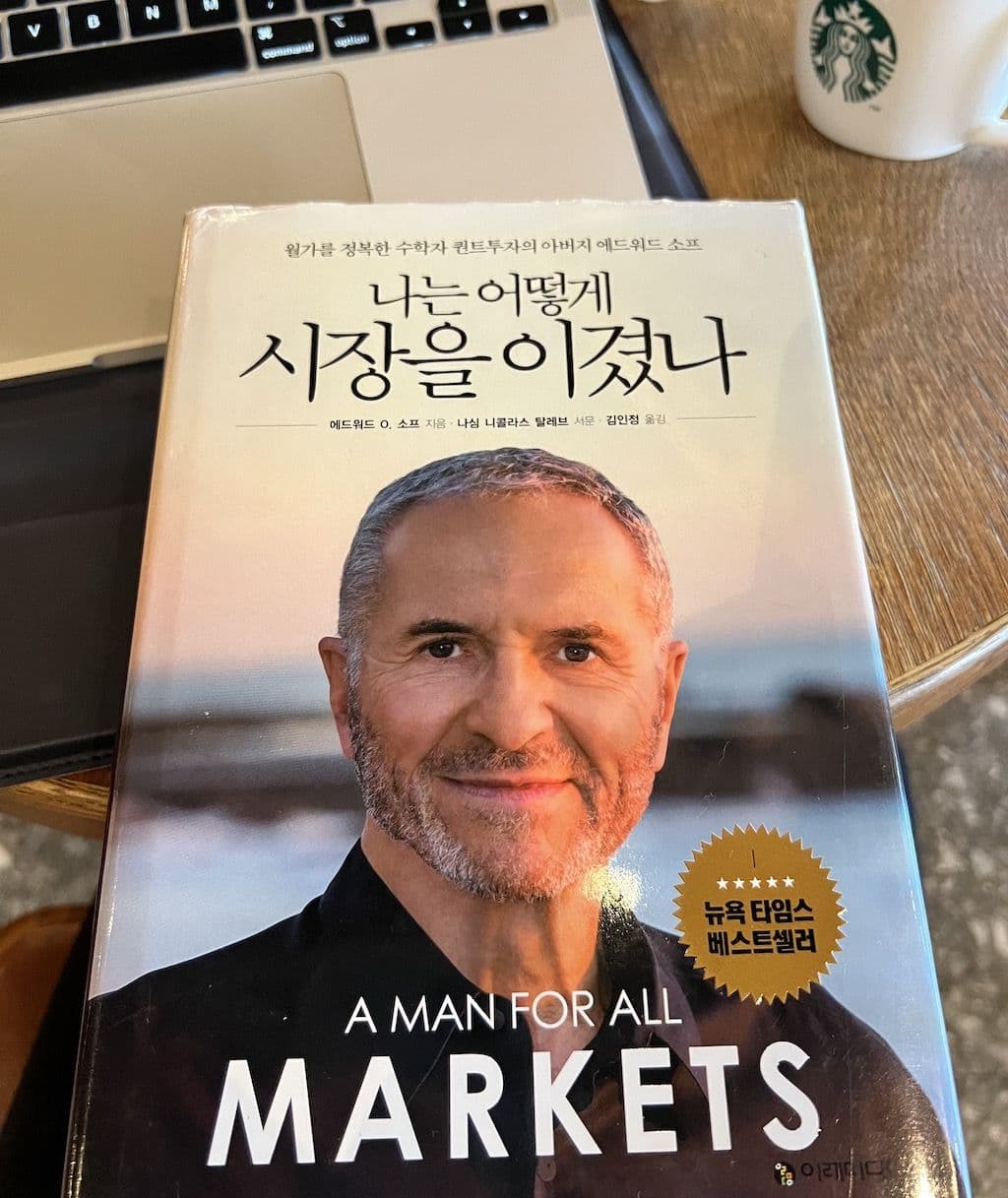
Since late last year I've been personally curious to learn about quantitative finance and quant investing. Looking for relevant books and resources, I found that the book written directly by Edward O. Thorp — known as the father of quant investing — was A Man for All Markets. Above all, a book written firsthand by the person who made a landmark contribution in a field seemed like the right introduction.
Searching for Edward, he may appear to be a genius straight out of Wall Street or a Hollywood film, but reading about his childhood — born in 1932 during the depths of the Great Depression, worrying about food and clothes — you can't say his life unfolded the way it did simply because he was a genius. His story holds much to learn about 'attitude toward life' through his curious childhood and the mindset he trained and emphasized.
I always try to limit how many excerpts I include in blog posts about books, but perhaps because reading time feels precious, I find myself wanting to share many passages exactly as they appear in the book. My personal thoughts are indicated with arrows below the excerpted lines. Please feel free to skim this as a book summary based on your own needs.
My experience of largely self-teaching, due to circumstances, led me to think differently. First, rather than simply accepting widely held views like 'it's impossible to beat the casino,' I had to verify them myself. Second, I developed new experimental methods to test theories — and as a result, I was able to derive the fruits of pure reasoning, including warrant valuation formulas, and make it routine to apply them productively. Third, when setting worthy goals for myself, I made realistic plans and persisted until succeeding. Fourth, I strove to maintain consistently rational attitudes not only in science as a specialized field, but in dealing with every aspect of the world. I also learned to suspend judgment until decisions could be grounded in evidence.
We analyzed and incorporated tail risk, asking extreme questions like 'What if the market drops 25% in a single day?' Ten years later, exactly that happened — and our portfolio was barely affected.
On Wall Street, there exists another kind of risk that computers and formulas cannot protect against: the risk of theft or fraud. My prior experience with card cheating at casinos proved to be valuable preparation for the larger-scale misconduct I would face in the investment world.
American corporate executives and directors were satisfied with the old ways. They owned cabins and private jets. They donated to charities for career advancement and personal purposes. They were generous to themselves with salaries, severance, cash, stock, stock option bonuses, and golden parachutes.
All of this was designed directly for their own benefit, with costs borne by the company. Those costs were customarily ratified by shareholders who were too scattered to organize effectively. Economists call this conflict of interest between management (agents) and the actual owners — shareholders — the principal-agent problem. This problem continues to this day.
I asked one of our traders — who was proud of having saved the company significant costs by delaying transactions to shave another eighth of a point off the price instead of trading at market — how they could know that the benefits of repeatedly saving an eighth of a point per share offset the cost of missing the opportunity. They couldn't demonstrate it.
→ Sometimes when I make stock trades I try to save a few hundred or thousand won by not trading at market price — and Edward's words made me reflect on that habit.
Trying to interpret the significance of trivial stock price movements is a constant in financial reporting. Journalists usually have no idea whether a stock price change is statistically common or rare. People commit the error of trying to find patterns or explanations where none exist. We saw this error in the history of systems-based gambling, the useless and excessive pattern-based trading techniques, and investing based on newspaper or magazine articles.
What is statistical arbitrage? Arbitrage originally refers to a trade where a pair of offsetting positions is taken to lock in a certain profit. For example, selling gold at $300 per ounce in London while simultaneously buying at $290 in New York generates $10 per ounce. Assuming the financing cost, insurance, and shipping from New York to London totals $5, the remaining $5 is profit — that is the original purpose of arbitrage.
The extended meaning of arbitrage refers to 'an investment that is expected to generate profit, though not certainty, by offsetting risk overall.'
Neither of us (the author and co-founder) believed in the efficient market hypothesis. The evidence against market efficiency was overwhelming: blackjack, Warren Buffett and his friends' historical investment returns, and our own routine successes at PNP. Rather than asking 'Is the market efficient?', we asked: 'How and to what degree is the market inefficient? And how can we exploit those inefficiencies?'
Staying ahead of the market is different from beating it. Staying ahead is simply luck. Beating the market means identifying a statistically significant and valid edge and using it to profit.
To beat the market, you must focus on investment opportunities within your sphere of knowledge and evaluation ability — your competence. Make sure your information is current, accurate, and essentially complete. Understand that information travels down a 'food chain' — those who get it first 'eat' and those who get it later 'are eaten.' Finally, unless you can demonstrate your edge logically and, where applicable, through a track record, you should not bet.
How to beat the market — just one of the following will suffice:
- Get good information early. How do you know if your information is sufficiently useful and timely? If you're not sure, you probably don't have it. When it becomes known that a security is mispriced and people act on it, the mispricing tends to disappear. If you've spotted an opportunity, you need to act before others do.
- Be a disciplined, rational investor. Follow logic and analysis over hype, whims, and emotions. Only assume you have an edge when it can be justified beyond reasonable doubt. Unless you have strong conviction that you have an edge, don't gamble. As Buffett says, 'Only swing at fat pitches.'
- Find superior analytical methods. What worked for me included statistical arbitrage, convertible security hedging, the Black-Scholes model, and card counting in blackjack. Leveraging the superior security analysis of a talented few and the techniques of excellent hedge funds is another winning strategy.
Investors who pursue profit by buying asset classes in uptrends and selling those in downtrends have historically recorded poor returns — particularly during the tech bubble that ended in 2000, the peak of housing price rises in 2006, and the stock market crash of 2008–2009. By contrast, 'contrarian' and 'value' investors who buy cheap and sell expensive achieve excess returns by rotating between asset classes.
While studying this problem (the 2008 financial crisis) at PNP, I learned that it was industry practice to assume default rates would follow normal historical experience. There was no attempt to quantify the possibility of large, rare negative events like the Great Depression — and the rapid acceleration of defaults — and adjust prices accordingly. The risk of black swans was not incorporated into pricing models.
Betting too early in the opposite direction can lead to short-term ruin even when you turn out to be right in the long run. As Keynes said, markets can remain irrational longer than we can remain solvent.
What about avoiding losses? Once a bubble is identified, you can simply choose not to invest. But the problem lies in the contagion of its effects. The 2006–2010 housing price collapse didn't just hurt speculators or those who bought in too late. Derivatives spread the damage across the globe.
→ This is one of the reasons why simple indifference or independent action cannot eliminate all market risk. It's the reason why, if you've decided to participate in a game, you need to make efforts to fix the game's flawed rules or errors.
How can we prevent future financial crises caused by leverage that is nearly unregulated systemically? One concrete step to limit leverage would be requiring both sides of a transaction to post sufficient collateral. That is precisely the role of futures exchanges, where contracts are standardized and regulation applies. A method that has worked for decades, is easily controlled by the exchange itself, and has caused almost no problems.
→ I know almost nothing about futures — this section is a cue for me to look into it.
American corporate executives gamble with shareholders' assets. When they succeed, enormous personal rewards follow; and if they fail, accommodating politicians often step in with public funds for rescue. America privatizes gains and socializes risk. The ability of corporate executives to appropriate public wealth is directly reflected in CEO salaries.
Moshe Adler noted in a column titled 'Down with the overpaid' that: 'Two hundred years ago, economists David Ricardo and Adam Smith concluded: 'A person's salary is determined not by their productivity but by their bargaining power. Why? Because production is generally collective... and each member's contribution cannot be separated from the contributions of the others.'"
→ Words I can now read calmly, but I find myself honestly asking: if I ever became part of the establishment, would I try to change the zero-sum rules that benefit me? I fear the self-contradiction that might emerge.
Personally, I think this final chapter is the heart of the book. It distills the message the author wanted to give readers through his own life.
Education brought great change to my life. In mathematics I learned to reason logically and to understand numbers, tables, charts, and calculations naturally. Physics, chemistry, astronomy, and biology showed me the wonder of the world and taught me how to build models and theories to explain and predict phenomena. As a result, I found rewards in both gambling and investing.
One of the important issues in public policymaking today is the trade-off between cost and benefit. Sometimes the choices are hard. Is it better to spend $500,000 to save one patient with severe drug-resistant tuberculosis, or to use the same amount to supply 50,000 doses of a $10 flu vaccine to students and save 50 lives? Statistical thinking helps with these choices.
I believe simple probability and statistics should be taught from kindergarten through 12th grade. And I believe that analyzing games of chance — coin flips, dice, roulette — helps people learn to think carefully about issues like the ones above. Understanding why casinos win allows you to limit losses to a light, playful level rather than becoming addicted to gambling.
→ Thinking about these dilemmas makes me newly feel how important education that makes society's members wiser truly is.
One of the greatest pleasures I've derived from studying investing, finance, and economics is gaining insight into people and society. In the natural sciences, there are rules that hold as universal truths — like the law of gravity. But humans and the ways humans interact cannot be addressed through comprehensive and unchanging theories, and never will be.
→ I always hold logical thinking rooted in mathematics and science in high regard — but this was a passage that reminded me once again of the importance of insight into people as well.
Of Charlie Munger's mental models rooted in multi-disciplinary insight, my favorite is what I call 'Look for the incentives' — understanding the motivations and interconnections behind transactions and phenomena. This is also closely related to the question 'Cui Bono?' — 'Who benefits?'
→ I think this is a mental model that can explain much of the actual direction in which people, organizations, and nations move.
This book is an autobiography that surveys the entirety of Edward's life. Rather than a book whose purpose is knowledge transfer, hearing the story that weaves through mathematics, casinos, finance, and investing through the lens of a lived life was far more resonant and engaging. In software development, one thing we must never forget is that behind every computer is a human being. In the same way, when I think about investing — and more narrowly, scientific method investing — in my mind I can picture a professor researching how to beat roulette and teaching mathematics to students, a boy making explosives and experimenting in his backyard — and I hope that will enable me to make decisions somewhat more grounded in Edward's kind of wisdom.
Edward's closing words at the end of the final chapter are simply beautiful. I'll let them close this review.
"Life is like reading a novel or running a marathon. It's not a problem of reaching a destination — life is the journey itself and the experiences along the way. As Benjamin Franklin said, 'Time is the stuff life is made of,' and everything depends on how that time is used.
The best moments in my life were the time spent with the people I love most — my wife, family, friends, and colleagues. Whatever you do, enjoy life, enjoy the time with the people you share it with, and leave the good that comes from you for the next generation."
Bookamid these days so full of AI-driven FOMO, to consider what kind of future for humankind we ourselves hope for.
 Book
Book Book
BookAs I've been getting more into tennis lately, the book <The Inner Game of Tennis> that I read about two and a half years ago came back to mind. When I first read it, I didn't know much about tennis, so I felt like I only understood about 30% of its message. Even so, the book's message about "relaxed concentration" was helpful for life in general — and with renewed passion for tennis, I was curious how differently it would resonate the second time.