 Book
Book7 min read
Thoughts on <DO HUMANKIND'S BEST DAYS LIE AHEAD>
amid these days so full of AI-driven FOMO, to consider what kind of future for humankind we ourselves hope for.
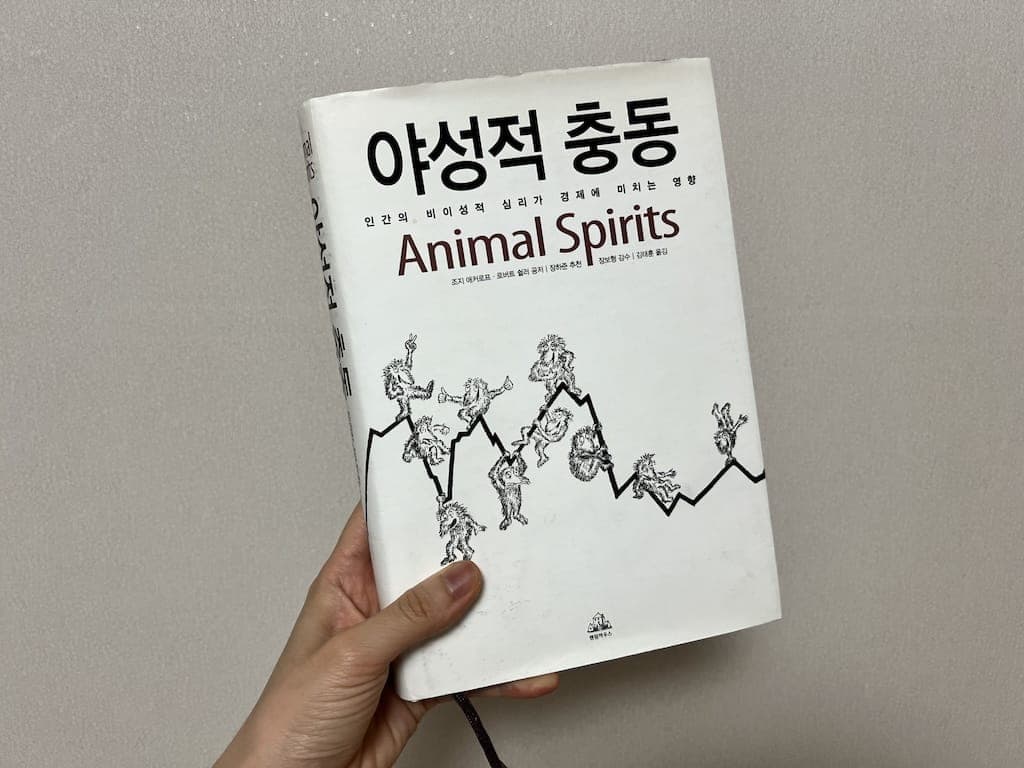
Honestly, I learned about this book as a recommended read back in 2013 and it kept nagging at me for a full ten years before I finally read it — a somewhat embarrassing but personally historic book. One reason I finally picked it up after a decade is that I've been spending more and more time on crypto and stock investing over the past year or two. The more I watch what people commonly call "the market," the more I feel that the human cultural and psychological elements that can't be explained by simple numbers and theories are at the very core. Hoping to ease some of that confusion, I thought it was finally time to really read this book.
The title "Animal Spirits" uses words that are somewhat unfamiliar in Korean, which may have made it feel unapproachable. But as the subtitle — "How Human Psychology Drives the Economy and Why It Matters for Global Capitalism" — suggests, what this book is trying to say is actually quite simple. Reading it, you start to feel that where conventional economics used to talk about rigid numbers, formulas, and laws, this book reads so much like a psychology book that you might wonder if you're reading economics at all.
Before reading this book, I honestly didn't know what Keynesianism was. I had only a faint memory of briefly seeing it in <Mankiw's Economics> in an introductory economics class in college. Having finished it, I now understand that this book argues that Keynes's original concept of "animal spirits" deserves our serious attention — and that forgetting what we learned after the Great Depression of the 1930s was the root cause of the financial crisis. So the very first page of the book opens with this passage from Keynes's The General Theory of Employment, Interest and Money:
Most, probably, of our decisions to do something positive, the full consequences of which will be drawn out over many days to come, can only be taken as the result of animal spirits — a spontaneous urge to action rather than inaction, and not as the outcome of a weighted average of quantitative benefits multiplied by quantitative probabilities.
The book is divided into two main parts. Part 1 explains the five irrational human psychological forces that make up the "animal spirits" theory. Part 2 answers 8 common questions about the economy to show how greatly animal spirits influence it. The book's Korean editor suggests that reading Part 2 first might be better for general readers, since it poses questions anyone has probably wondered about. However, since Part 1 concepts are repeatedly referenced throughout Part 2 with examples, if you do choose to read it, I'd recommend reading in order — with a bit of tolerance for the slower pace.
Here I'll summarize the core of each part. Part 1 identifies five aspects of animal spirits that influence the economy:
Part 2 covers how these five animal spirits can explain major questions about the economy. The 8 questions are:
I'd encourage you to read the book to savor the authors' detailed answers. A few messages I took from Part 2: the authors argue that what was needed during moments like the 2008 financial crisis was the more active, appropriate government intervention that we had learned and practiced following the Great Depression. They re-emphasize that the original purpose of the Federal Reserve — born from many historical experiences of psychological panic causing bank runs and financial crises — was to act as a stopper that keeps the first domino from toppling the others. And above all, they argue that too many macroeconomists and finance professionals have become so captivated by "rational expectations" and "efficient markets" that they are missing the most important dynamic at the base of economic crises.
Traditional economic theory has no room for the principles of animal spirits. It excludes the fundamental dynamics that cause change and crisis. It does not account for the loss of confidence and trust, the perception of fairness that suppresses wage and price flexibility, the effect of bad financial products during boom times and the corruption that enables it, the effect of the exposure of that corruption when bubbles burst, or the influence of the stories through which we interpret the economy.
Reading this book, I often felt that the authors' arguments and evidence didn't feel logical or scientific — probably because the approach was so different from economics books that typically express things in equations and graphs. It felt more like reading a psychology book, with many social experiment examples — similar to <Influence: The Psychology of Persuasion>. Holding onto this skepticism as I read, I eventually reached the "conclusion" section, where the authors themselves acknowledge that this book does not offer specific answers to all the questions it raises; its purpose was to suggest a direction of thinking — that how economies work and the role government plays within them cannot be explained by economic incentives alone. Having read that admission, the parts I'd found insufficient throughout suddenly made sense as being intentional.
Having finished the book, I'm still personally left with one question: why did the authors choose these particular five animal spirits from among the many irrational human emotions? For example, just as Charlie Munger said "the most dangerous psychology to guard against is not greed but envy," envy also strongly influences human decision-making and thus must have a significant economic impact. I think the book would feel even more complete with an explanation of why these five are especially important.
What I took away from this book is a firm awareness that human psychological, social, and cultural factors cannot be ignored when interpreting investment markets. I'll likely pay more attention to behavioral economics and try to understand it better going forward. And Charlie Munger's statement — "The core content of psychology, which I call 'The Psychology of Human Misjudgment,' is enormously important and must be learned" — is something I now find a little more relatable and comprehensible.
Investing, markets, and the future still feel vague and difficult. But through this book, I was able to recognize a version of myself that had been relying too heavily on "efficiency" and "rationality" to explain phenomena. For the aspects that can't be explained by efficiency and reason, I now have more diverse perspectives to consider — rather than feeling frustrated or dismissing them — and that's where I find the meaning of this reading.
Bookamid these days so full of AI-driven FOMO, to consider what kind of future for humankind we ourselves hope for.
 Book
Book Book
BookAs I've been getting more into tennis lately, the book <The Inner Game of Tennis> that I read about two and a half years ago came back to mind. When I first read it, I didn't know much about tennis, so I felt like I only understood about 30% of its message. Even so, the book's message about "relaxed concentration" was helpful for life in general — and with renewed passion for tennis, I was curious how differently it would resonate the second time.