 Book
Book7 min read
Thoughts on <DO HUMANKIND'S BEST DAYS LIE AHEAD>
amid these days so full of AI-driven FOMO, to consider what kind of future for humankind we ourselves hope for.
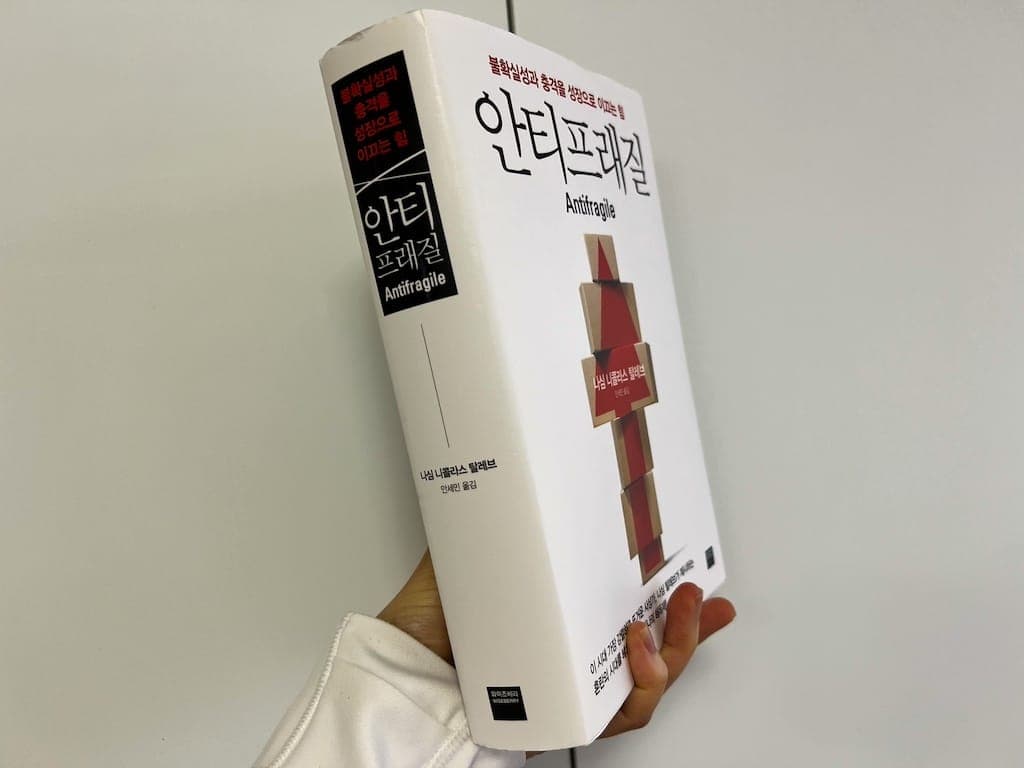
Several years have passed since I learned about , a follow-up to by author Nassim Nicholas Taleb. I had been keeping it in the back of my mind, and finally picked it up with the expectation that its catchphrase — "the force that turns uncertainty and shocks into growth" — might offer exactly what's needed in situations like investing, business, and everyday life.
Before actually receiving the book, I hadn't realized it was an intimidating 660 pages of text alone 🫠. On top of that — as I felt when reading — Nassim Taleb's writing is a style I find hard to absorb in one reading. Trying to understand every single point made it impossible to make progress and only accumulated stress, so there were parts where I grasped just enough of the intended message and skimmed through the detailed examples and explanations.
Ultimately, this book aims to define a new term — "antifragile" — and invites the reader to interpret the world through that lens. So if you understand antifragile, it's much like having read half the book. A simple comparison: when subjected to shock (stress), something that grows stronger is "antifragile"; something that breaks and disappears is "fragile."
The author explains the antifragile framework through many examples and angles. For those curious about the details, I recommend reading the book directly. Below, I've distilled the keywords that helped me understand antifragile into a diagram.
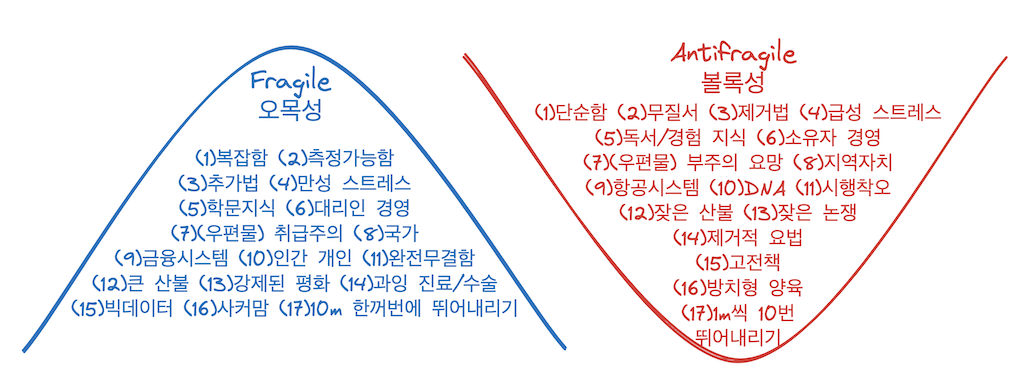
<Fragile vs. Antifragile comparison>
Deliberately avoiding antifragility, the author argues, inevitably makes you more fragile. For example: a failing financial system that would naturally have gone bankrupt is kept alive at taxpayer expense through bailouts — an intentional intervention — creating a fragile structure that later causes even greater damage. Following the principle of natural selection, the argument is that losers in competition should be left to fail rather than overprotected, so that the overall structure can become antifragile. It's a harsh principle, but as I read it in a calm state, I found myself agreeing.
The concept that fragility and antifragility exhibit "path dependency" was also helpful. Simply put, order matters — the outcome differs depending on the sequence. Applied to our economy: raising GDP growth while the economy is in a fragile structure only makes it more vulnerable to risk, so it's meaningless. Passing debt to future generations easily boosts GDP, but the fragile economic structure built this way eventually collapses under that debt.
Another concept I found helpful from the book is "options." An option refers to something with an advantage through "asymmetry" — when a decision is made, it carries limited downside if the outcome is negative, while offering unlimited upside if the outcome is positive. Choices that have the character of options enable good decision-making.
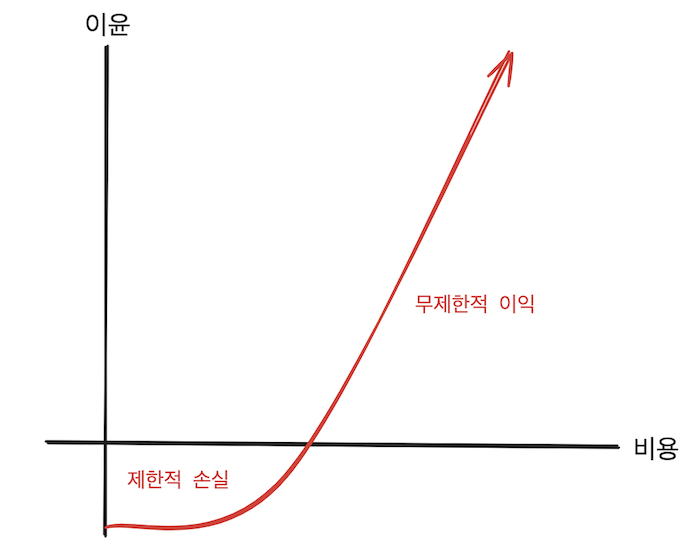
A graph representing the "option"
Of course, options can be misused and make the entire system more fragile. In corporate governance or politics, people obtain "free options" — taking gains when things go well, but bearing no accountability or losses when things go wrong — which ultimately harms everyone.
As the author approaches the conclusion chapters, he goes beyond explaining antifragile to discuss the effort we must make to become antifragile, and what ethics means from an antifragile perspective.
His core message can be expressed simply as Hammurabi's Code: "an eye for an eye." Anyone who proposes a decision must have skin in the game — bearing the consequences, whether gains or losses. The author is very critical of anyone who gives opinions without having any skin in the game.
He calls this "skin in the game." Sacrifice and honor sit at two extremes, and leaders should be recognized in positions where their interests align with outcomes. In ancient times, generals and commanders were those who could be the first to die when war broke out; mafia bosses were in positions most exposed to enemies' attacks and most likely to receive the harshest sentences from authorities. The author argues that while skin in the game existed in the past, today it goes unrecognized — and he criticizes Wall Street bankers, big-company executives, and politicians who steal "free options."
I'd also want to surround myself with outstanding people who practice skin in the game. As an extension of this thought: you can learn more truth by looking at what someone actually did in the past, rather than what they say or opine after the fact.
To be honest, there are a few parts of Nassim Taleb's thinking that I find hard to fully accept. Depending on the scope of consideration, his arguments and examples sometimes contradict each other.
Even so, the concept of antifragile is like a useful tool — one to use well when interpreting phenomena or making important decisions. This reading gave me a tool I can reach for when needed. In particular, the cognitive biases that are easy to fall into — like mistaking absence of evidence for evidence of absence, or the turkey problem — are points I want to keep somewhere in the back of my mind, ready to surface when needed.
Bookamid these days so full of AI-driven FOMO, to consider what kind of future for humankind we ourselves hope for.
 Book
Book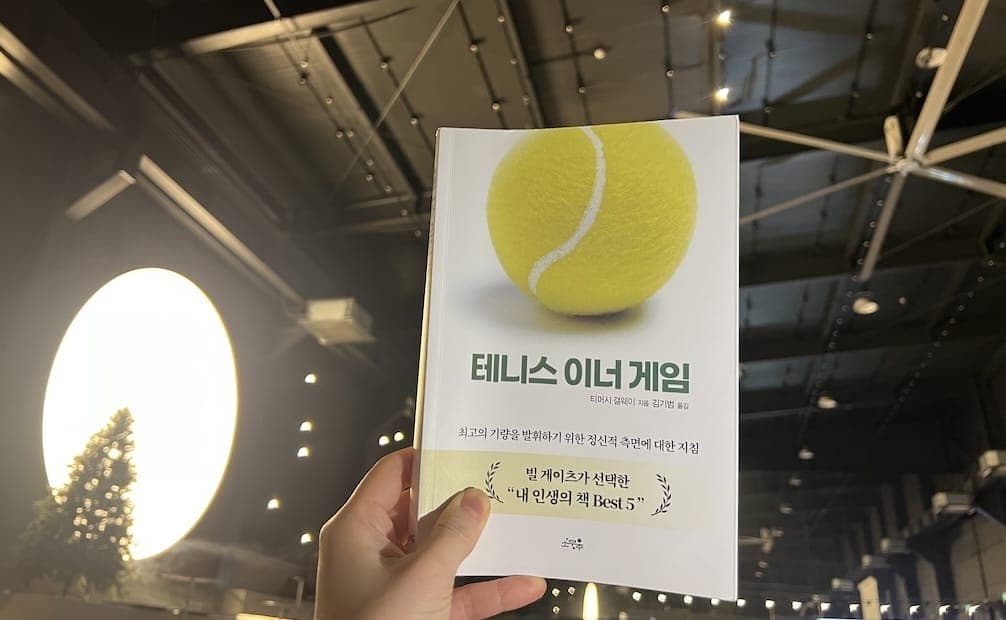 Book
BookAs I've been getting more into tennis lately, the book <The Inner Game of Tennis> that I read about two and a half years ago came back to mind. When I first read it, I didn't know much about tennis, so I felt like I only understood about 30% of its message. Even so, the book's message about "relaxed concentration" was helpful for life in general — and with renewed passion for tennis, I was curious how differently it would resonate the second time.