 Business
16 min read
#8 Are the Print Shops in Chungmuro Making Money?
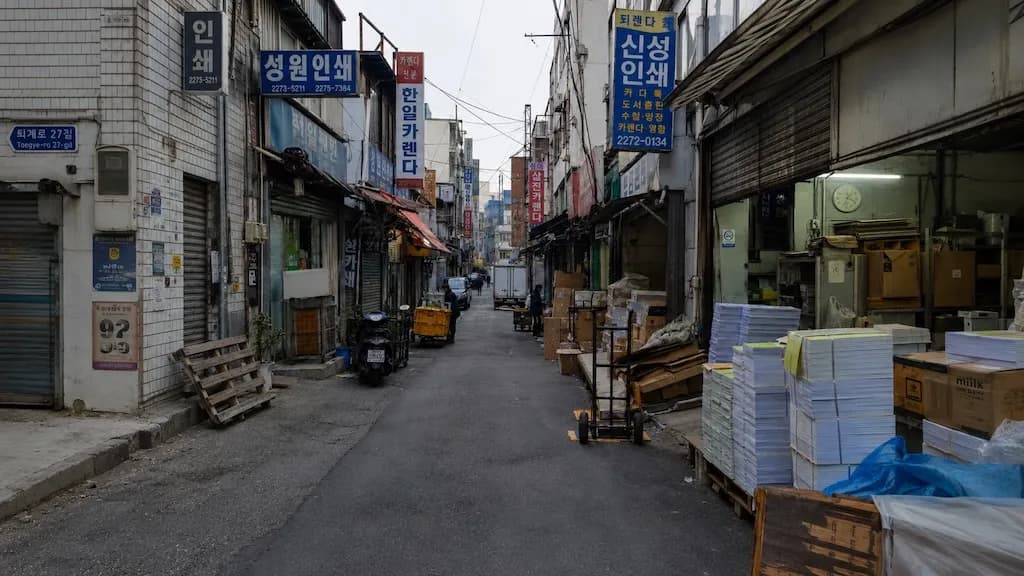
I wanted to understand why Chungmuro has so many print shops.

Disclaimer: Based on a presentation delivered at Seoul National University's blockchain club Decipher at a Weekly Session on the topic 'The Future of Banking.' This article examines banking as a business model and blockchain as a new technology — exploring what new forms of banking might emerge when the two combine, and what changes are already underway. Nothing in this report constitutes investment advice, nor should it be interpreted as such.
This article is a verbatim copy of a piece I wrote for the Decipher Medium channel. To read it there, visit this link.
On the day this was published, Xangle also happened to publish a digest of a webinar on CBDCs and stablecoins. I recommend reading my article first and then Xangle's — together they make for a much richer understanding of CBDCs in particular.
The Banking Business Model
Changes Already Underway
Summary Conclusions
Blockchain has attracted attention since its emergence as a potentially revolutionary technology capable of solving the problems of the existing financial system. Examining the actual changes that have occurred since blockchain technology appeared will therefore help us understand its utility and value. Among those changes, I was struck by the idea that blockchain technology combined with the existing banking business model has given rise to entirely new forms of banking. This article analyzes the essence of the traditional banking business in depth, and compares it with these newly emerging forms. It also examines, function by function, how blockchain technology has specifically influenced the rise of new banking.
In this section, I review the roles of banking that haven't changed over time, look at the revenue model of Korean banks, and reflect on the essential nature of banking as a business. To understand the unique role of banks, here are the three historical roles banks have played:
Bank Role 1: Lending Money
Even in ancient Mesopotamia, there are traces of lending goods in exchange for agricultural produce. Clay tablets found at Mesopotamian sites record how much barley the tablet-holder would receive at harvest time, or that a certain amount of silver would be paid at maturity. These tablets were issued only through royal palaces or temples, with authority and credibility established through centralized power.
Bank Role 2: Safeguarding Money
The safekeeping role is the basic function modern people expect from banks — and in some sense the most foundational. What we know today as banknotes and certificates traces back to ancient Greek city-states. In ancient Greece, wars between city-states were frequent, and the safest place to store precious metals with exchange value was religious temples. What gave people confidence in these temples was the religious belief that "stealing from a temple brings divine retribution." Even then, a storage fee had to be paid to deposit precious metals at a temple. Moving forward to 13th-century medieval Europe, people began entrusting their precious metals to goldsmiths. Goldsmiths already possessed strong safes for their raw materials (gold, silver) and had the ability to assess the purity of precious metals — establishing their credibility. They issued receipts as proof of storage. As more people stored their metals, exchanging receipts instead of the physical metal became common. As receipt trading grew active, goldsmiths discovered that less than 10% of the gold in their care was ever actually claimed. They began lending out the surplus gold to those who needed it — and thus lending was born. This empirically derived 10% claim rate evolved into the modern concept of the "reserve ratio." When the real owners of the gold learned that goldsmiths were building wealth from their deposits, they objected — and goldsmiths began sharing a portion of their lending interest with the depositors, giving rise to the modern concept of "deposit interest."
Bank Role 3: Exchanging Money
No history of banking is complete without Venice, Italy. Renaissance Italy was the hub of Mediterranean trade, and because each city-state had its own currency system, a middleman was needed to exchange currencies for trade. Professional money changers set up with scales and benches to do business with merchants — and from the Italian word for bench, banco, the word bank was born. As an aside, as the currency exchange business flourished, some changers went bankrupt — and from banco rotto (broken bench), the word bankruptcy was born.
These five functions, developed by humanity out of necessity, have been refined and elaborated over time:
Five Functions of Banking
As society advanced, these functions were embodied in different types of banks specialized for different purposes. In Korea, banks are divided into the central bank (which manages currency) and deposit banks (accessible to ordinary consumers). Deposit banks are further categorized by their governing law: commercial banks and regional banks under the Banking Act; specialized banks under Special Banking Acts; and internet-only banks under the Internet-Only Bank Act.
Even looking at the banks listed above, banks feel like a colossal presence to ordinary people — a business only entities with close ties to central government can operate. One of the biggest reasons for that feeling is that banking is one of the most heavily regulated industries. Comparing the key legal requirements for each type of bank gives a sense of just how burdensome it can be to "found" a bank.
Commercial banks
Specialized banks
Savings banks
Internet-only banks
Non-bank electronic finance (e.g. Naver Pay, Kakao Pay, Toss Pay, Samsung Pay)
These laws were created to find the right role for banking between protecting depositors and maintaining the positive function of banks in the capital market. But even this body of regulation hasn't kept pace with an ever-faster-changing era, and banking itself has hit a point of stagnating growth. So the banking industry and policymakers are exploring voluntary approaches like small licenses (license granularization) and challenger banks to strengthen competitiveness. Challenger banks — active particularly in the UK and overseas — are banks targeting small, niche customer segments with high-quality service specialized in specific financial services. Think of it as regulation-backed "micro-entrepreneurship" in banking.
Challenger bank example 1: The Oakwood State Bank
Oakwood State Bank is a bank in the rural Texas town of Oakwood. Founded in 1900, it has no internet banking and not even an ATM. As of 2008, it served about 600 customers — all townspeople, identifiable by voice alone. As of end-2014, total assets were approximately $6 million and net income around $100,000. Tiny compared to the banks we picture — but with a return on assets above the U.S. bank average of 1%, arguably more stable and sound than conventional banks.
Challenger bank example 2: Raiffeisen Gammesfeld
Raiffeisen Gammesfeld is one of Germany's smallest banks. It handles only traditional retail banking and has exactly one full-time employee: Peter, who does everything from customer service to cleaning, and still uses a typewriter for much of his work. Serving about 400 customers with steady annual profit of roughly €40,000, it won't do business with anyone who isn't a resident of Gammesfeld — and reportedly turned down calls from people wanting to entrust their savings during the 2008 financial crisis because they weren't townspeople.
These two examples make it possible to think about banking a little more lightly than we might otherwise — and from there, to wonder: could we actually "found" a bank? If someone sustainably implemented a few of the five bank functions above and had satisfied customers, they could arguably run a bank.
To understand banks from a more economic perspective, we can analyze their financial statements. Rather than focusing on a single type, I compare the business models of the three Korean banks with the largest KRW deposit bases in each category: the Bank of Korea (central bank), KB Bank (commercial bank #1 by market share), and KakaoBank (internet-only bank #1).
Before diving in, banks have two main ways of making money. First is interest income — primarily what we call the deposit-lending spread: the difference between the lending rate banks charge borrowers and the deposit rate they pay depositors. Investment interest from placing assets acquired through deposit-taking into securities is also interest income. Second is non-interest income — fees from selling financial products (cards, trusts, insurance) and investment gains from selling equities, bonds, real estate, etc.
Korean banks (as of 2019) have interest income accounting for 86.2% of total income, far above the non-interest income share of 13.8%. Overseas banks operate at 50–64% interest income, making Korean banks unusually dependent on it. Interest income is directly sensitive to macro conditions like interest rates; when rates stay low or NIM (net interest margin) narrows, the risk is significant. Non-interest income, by contrast, can be maximized by how creatively the bank designs financial products — making it the healthier long-term revenue lever. Korean banks are discussing overseas expansion, regulatory relaxation, and product innovation as solutions.
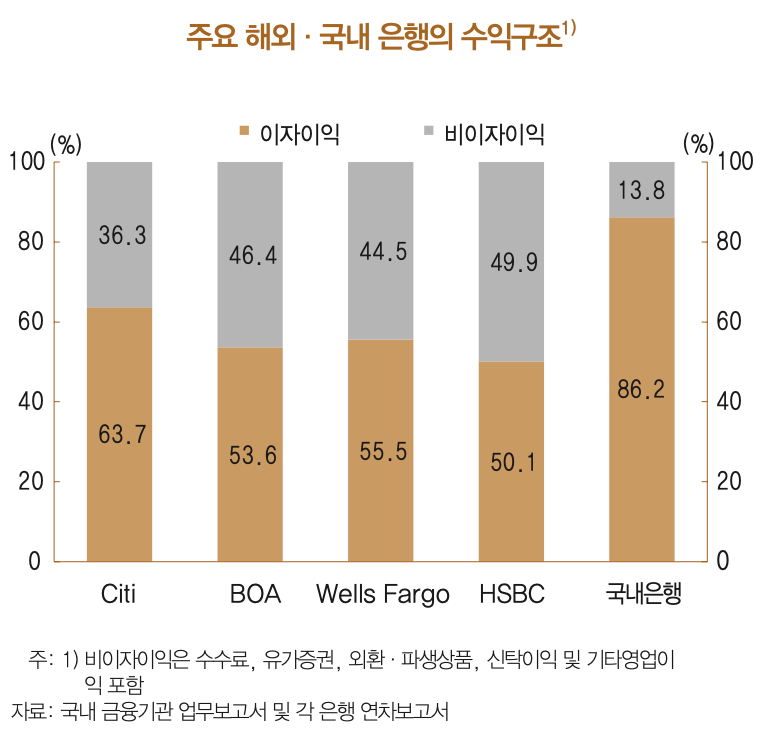
Source: "The Future and Implications of Korea's Banking Industry" research paper (Apr 2020)
Bank of Korea Financial Statements
The Bank of Korea (BOK) has an unusual revenue-cost structure, given its special purpose of circulating currency.
Balance Sheet (as of Sep 2023):
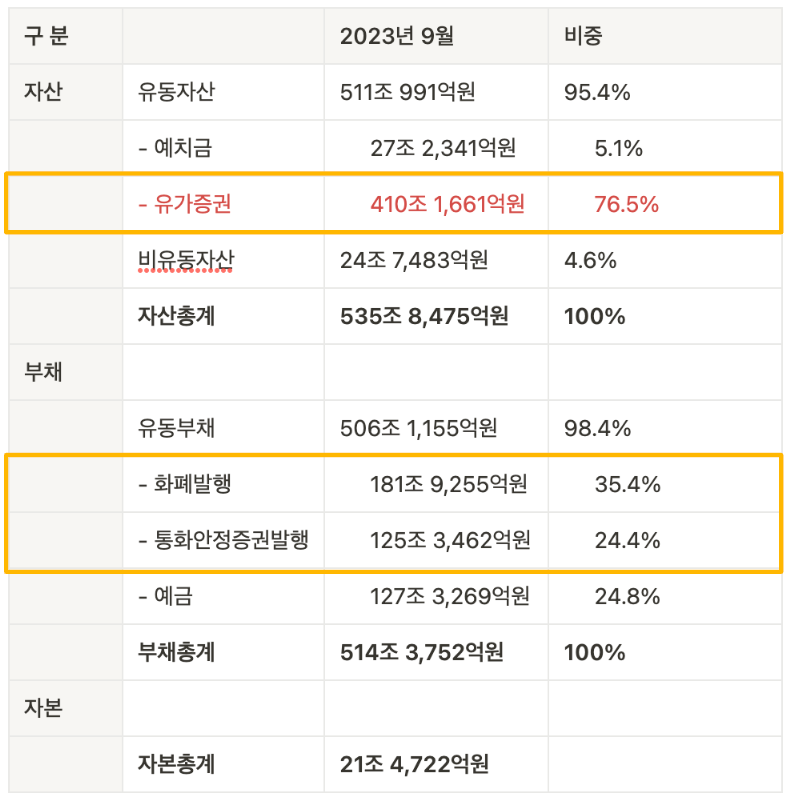
Source: Bank of Korea
Typical banks hold primarily "loans" (money lent to borrowers) as assets and "deposits" (money received from depositors) as liabilities. The BOK's balance sheet, however, shows no loans or deposits — instead, "securities" dominate assets and "currency issued" and "monetary stabilization bonds issued" dominate liabilities. The BOK uses its self-issued currency to buy U.S. Treasuries, bank bonds, and other securities — building a large "securities" asset — and issues new currency or its own bonds (monetary stabilization bonds) to make up most of its liabilities. This balance sheet confirms the BOK's role: adjusting the money supply by issuing and withdrawing currency.
Income Statement (2021–2022):
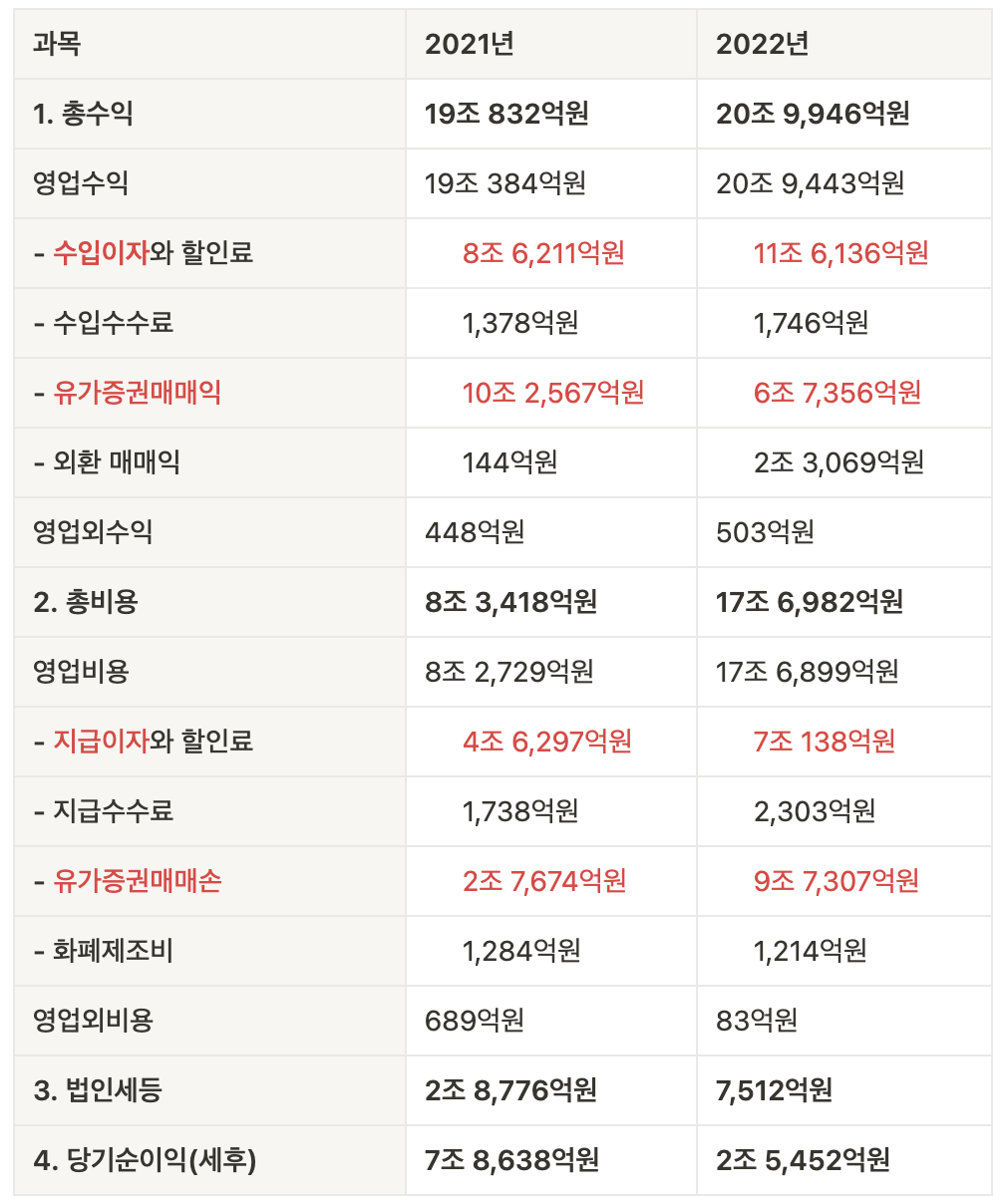
Source: Bank of Korea
The BOK's primary revenues come from interest on the securities (mainly U.S. Treasuries) that form most of its assets, plus capital gains from securities trading. Because of this, BOK profit swings by trillions of won depending on U.S. Treasury yields and prices. Costs include ordinary operating expenses (₩430 billion in 2021) and policy costs of ₩10.78 trillion — interest on the monetary stabilization bonds (₩1.46 trillion), foreign asset management costs (₩2.77 trillion in securities trading losses), and currency production costs (₩128.4 billion).
The BOK earns an annual after-tax net profit of roughly ₩2–7 trillion. After setting aside 30% as legal reserves, the remaining surplus is transferred to the national treasury. In effect, the BOK contributes approximately ₩2–6 trillion to the national treasury each year.
In a word: the BOK is a massive national asset management company managing approximately ₩600 trillion in assets.
KB Bank Financial Statements
KB Bank, Korea's #1 commercial bank by market share, had ₩517 trillion in assets as of 2022 — similar in scale to the BOK. But asset and liability type and the income statement details differ significantly.
Balance Sheet:
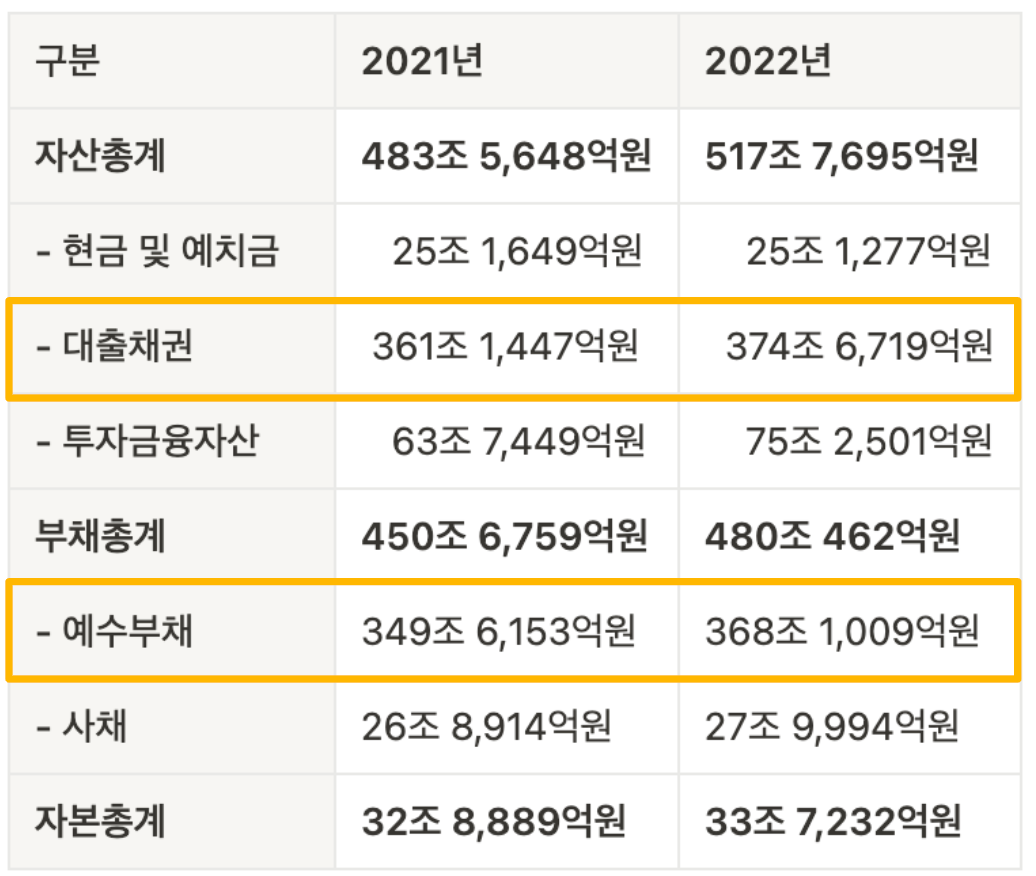
Source: KB Bank annual report
KB Bank's income statement is dominated by "net interest income" — the deposit-lending spread. Unlike the BOK, which has no special advantage in securities, KB Bank fills nearly 90% of total operating income with net interest income. Its cost structure is also different: while the BOK's costs are mostly policy costs, KB Bank's largest cost item is general and administrative expenses.
The BOK, as a large asset manager exposed to macroeconomic volatility, sees wide swings in net income (₩2–7 trillion). Commercial banks like KB, where both deposit rates and lending rates move with interest rates simultaneously, have a more stable spread — so NIM is more predictable. Commercial banks, with loan receivables making up most of their assets, can be summarized as a business operating on a single specific revenue structure: the deposit-lending spread.
KakaoBank Financial Statements
I included the internet-only bank as a case study of new changes within the existing banking industry — to see whether it has a differentiated revenue structure.
Balance Sheet and Income Statement:
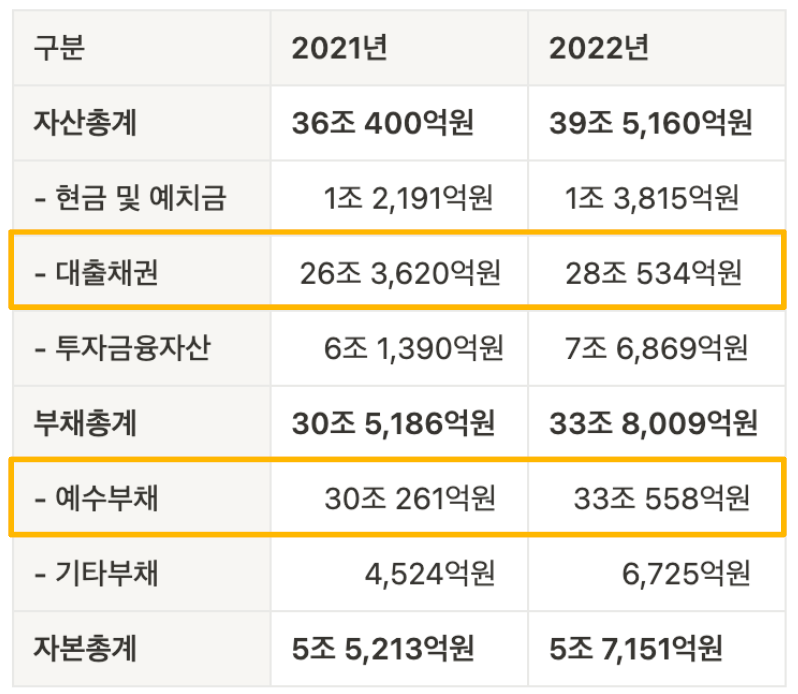
Source: KakaoBank annual report
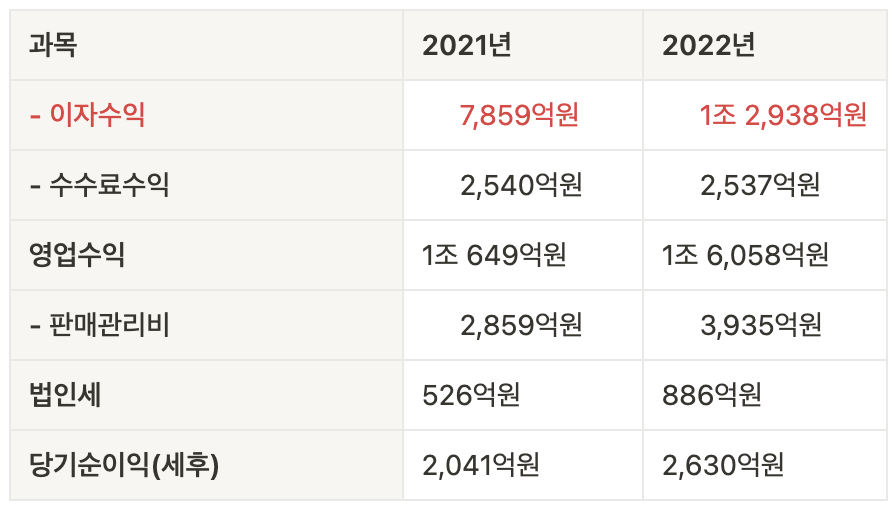
Source: KakaoBank annual report
The structure is similar to a commercial bank, with scale being the main difference given KakaoBank's shorter operating history. One notable distinction: KB Bank's general and administrative expenses are over 45% of operating revenue, while KakaoBank's selling and administrative expenses are just 24% — a much lower fixed-cost ratio, suited to the internet-only model.
If a regular company had liabilities accounting for over 90% of total assets, we'd consider it severely distressed. Banks, by contrast, have a business structure where most of their assets are liabilities by nature — and they earn returns on those assets through interest collection or capital gains. This revenue structure is both constrained by law and, once inside the legal framework, guaranteed to generate revenue.
As we've seen, the BOK is a large asset management company and commercial banks are a business of extracting deposit-lending spread at scale. Viewed from this angle, the existing bank business model closely resembles the stablecoin business model in today's blockchain industry. As shown below, the structure of customers depositing/withdrawing fiat currency to exchange for cryptocurrency echoes the bank functions of deposit-taking, financial intermediation, and credit creation.
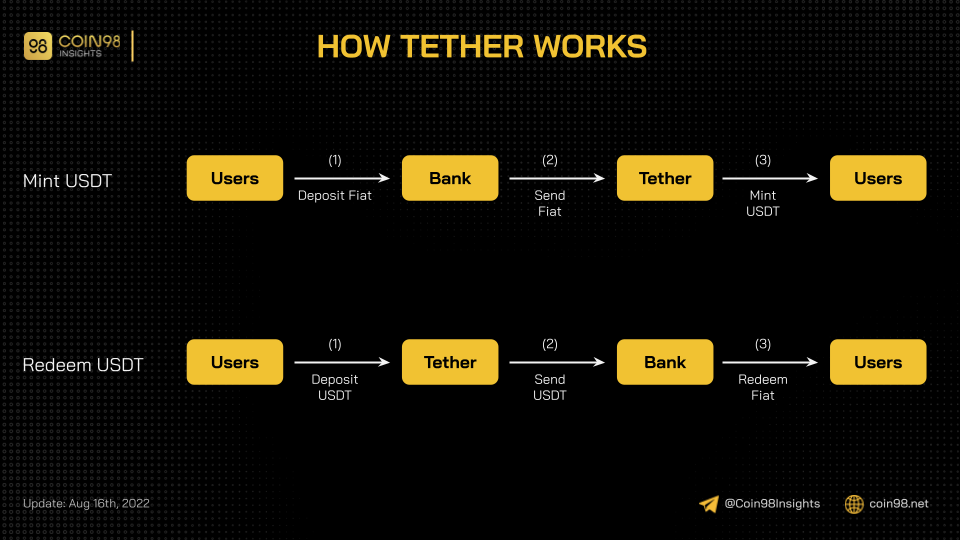
Source: COIN98 Insights — Tether service flow
To see how stablecoins compare to traditional banks, I examine the asset composition of $USDT and $USDC — the #1 and #2 stablecoins by circulation as of this writing.
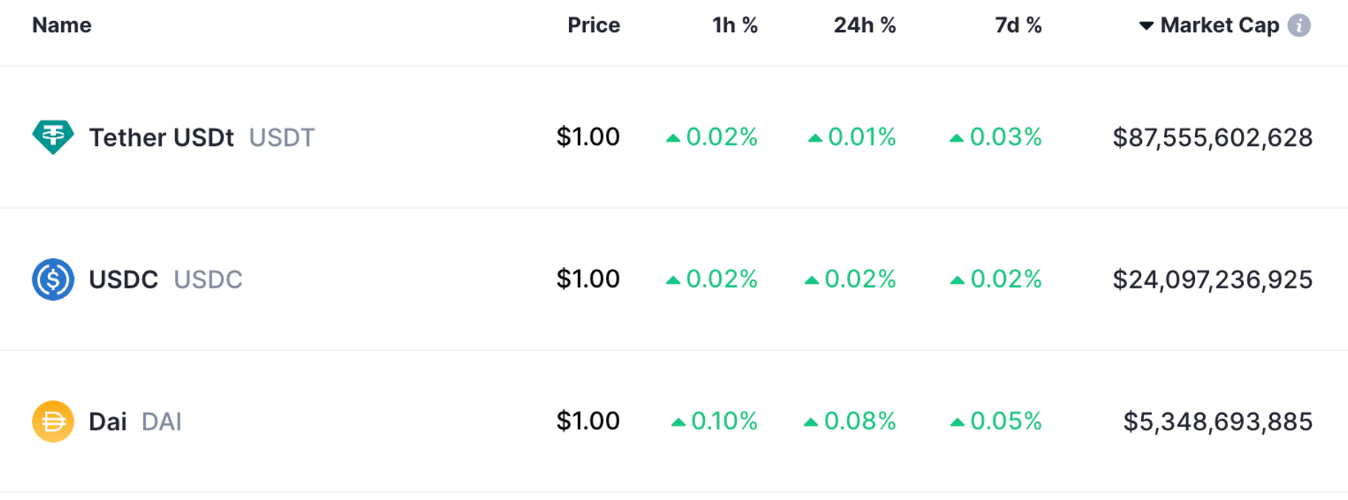
Source: CoinMarketCap — top 3 stablecoin market caps (Nov 17, 2023)
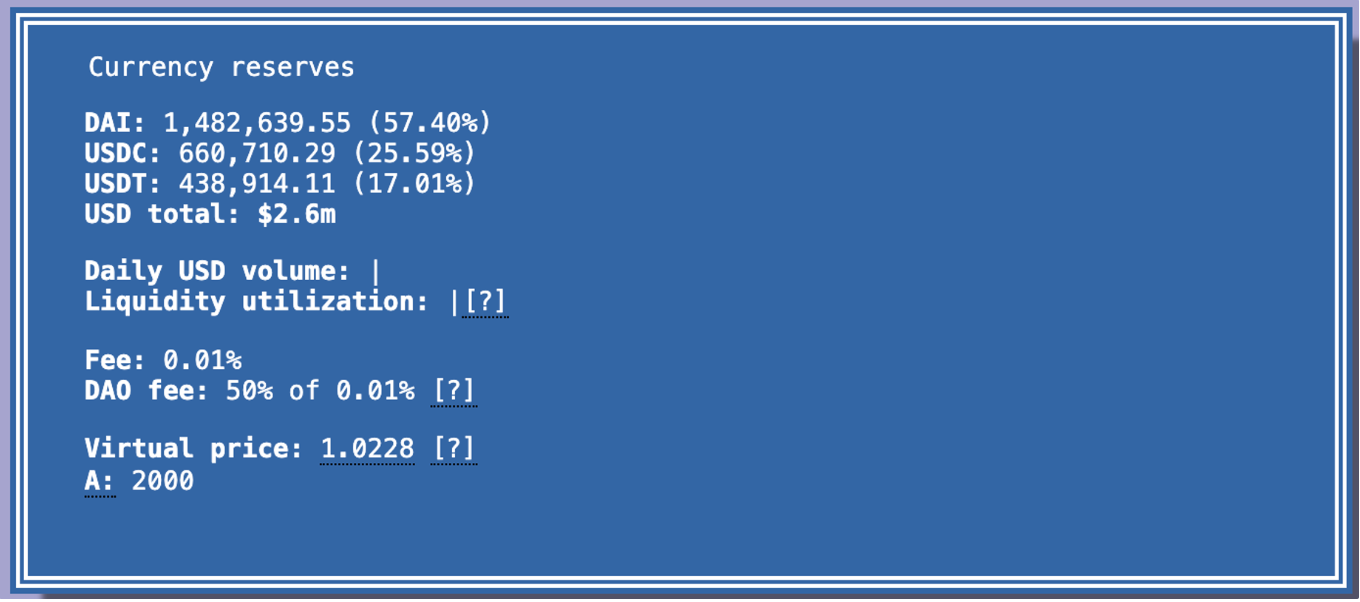
Source: Curve 3pool reserves (Nov 19, 2023)
Tether Ltd. — $USDT
Tether Ltd. is incorporated in the British Virgin Islands and is not subject to regulatory oversight, so it has no obligation to file reports in the same form as a regular company's audit report. Instead I examined which asset types Tether uses to hold and manage the USD it acquires.
Asset composition:
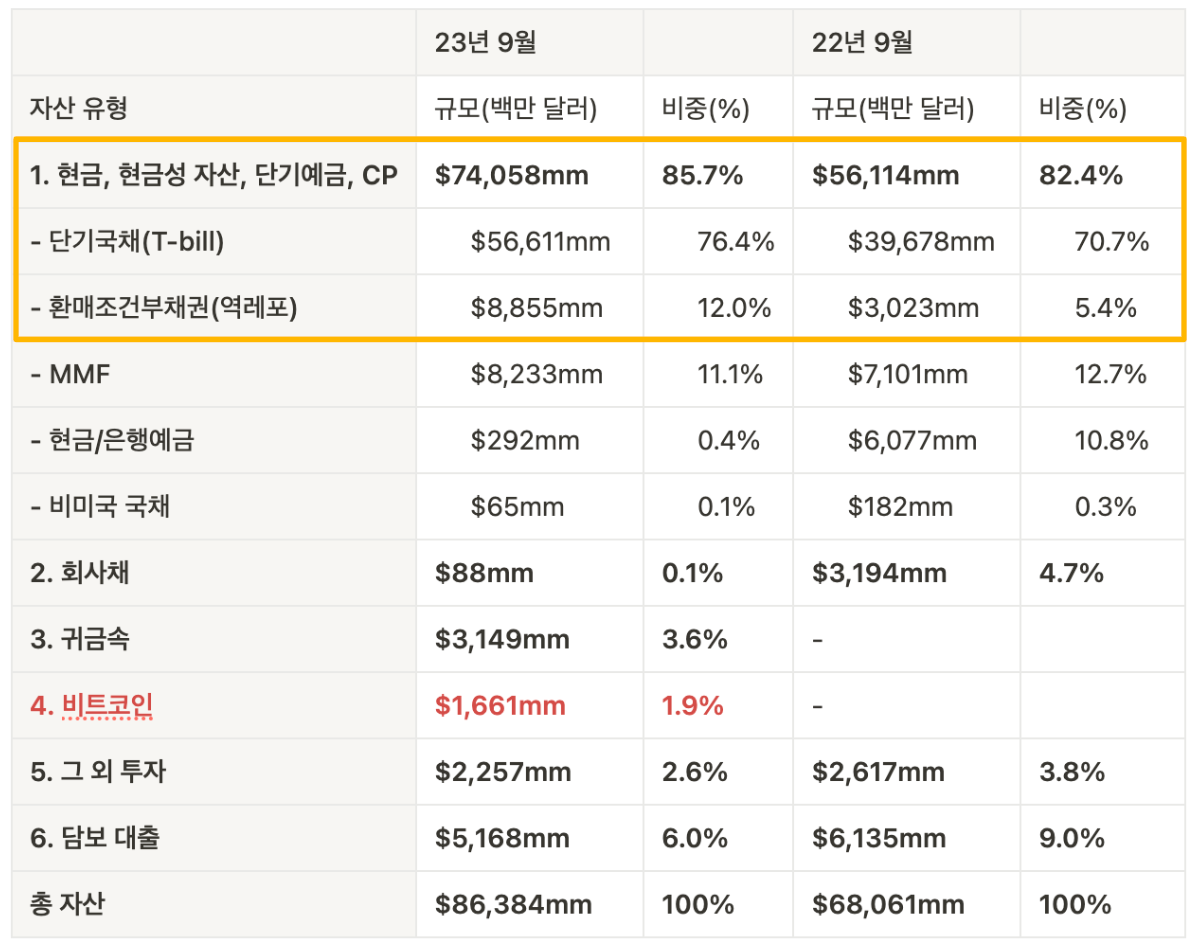
Source: Tether Independent Auditors' Report
According to Tether's published report, total assets as of Sep 30, 2023 were approximately $86.3 billion — up from ~$68 billion a year earlier, a 26.9% increase. This scale of asset growth in a single year is unlike anything seen in traditional banking. Another key characteristic: Tether holds most of its assets in highly liquid cash equivalents. The majority are U.S. Treasury bills (T-bills) and repos — a composition similar to the "securities" assets on the BOK's balance sheet.
A uniquely crypto asset class: Tether began including Bitcoin in its portfolio this year. In an official announcement in May 2023, Tether said it would regularly use up to 15% of profits to purchase Bitcoin. Based on the quarterly asset reports, with 1 BTC ≈ $27,000 as of Sep 30, 2023, Tether is estimated to have purchased approximately 61,518 BTC — roughly 15,000+ BTC per month from May through September.
Revenue estimate:
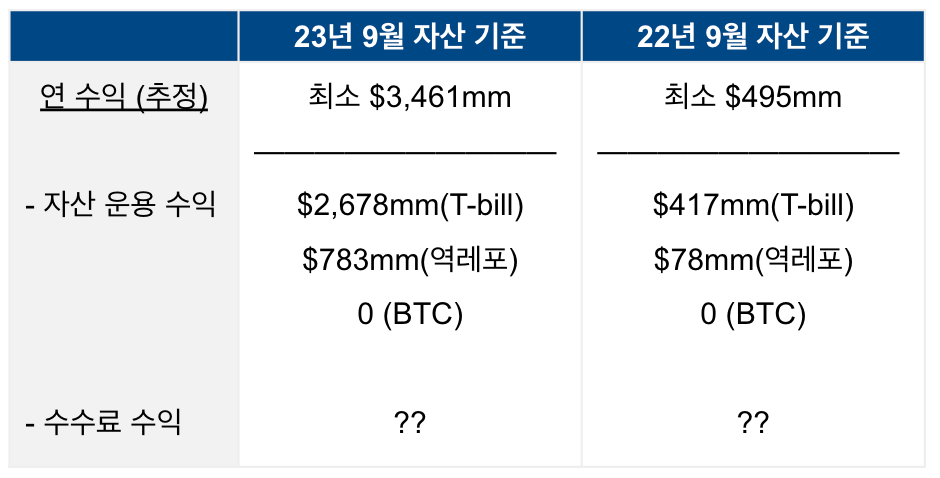
Source: Self-estimated from publicly available T-bill and reverse repo rates
Tether's revenue is not officially disclosed; only rough estimates are possible. According to Barron's, Tether's 2023 revenues are estimated at approximately $6 billion — expected to exceed BlackRock's estimated $5.5 billion, despite BlackRock managing $9 trillion in assets.
Tether's revenue falls into two categories: asset management income and deposit/withdrawal fees between USD and USDT. For asset management income, I multiplied the 1-year average T-bill rate (1.05% for Sep 2021–Sep 2022; 4.73% for Sep 2022–Sep 2023) and average repo rate (0.77% and 4.58% for the same periods) by the respective asset amounts. Even by very conservative estimates, approximately $3.4 billion in asset management income can be inferred.
On the cost side, the contrast with commercial banks is stark. Tether pays no deposit interest to USDT holders on their fiat deposits. Instead, holders pay fees to deposit and withdraw. Tether also needs no physical branches or infrastructure — costs beyond headcount are negligible.
Conclusion: Tether is a business managing approximately ₩100 trillion in assets and earning minimum ₩4.5 trillion in revenue. Tether's officially published Q1 2023 net income was $1.4 billion; Q2 operating income was $1 billion. Estimating $4+ billion in full-year 2023 revenue is not unreasonable.
Circle — $USDC
$USDC is issued and burned by Centre, a joint venture between payments company Circle and Coinbase. Unlike Tether, USDC operates under strict U.S. regulatory oversight, transparently publishing monthly auditor-verified reserve asset values. This transparency helped USDC close the gap with USDT — until a significant portion of the cash portion of USDC reserves (20%) turned out to be deposited at Silicon Valley Bank, which collapsed last year. Trust in USDC's backing assets fell, and USDC's market share has declined since.
Asset composition:
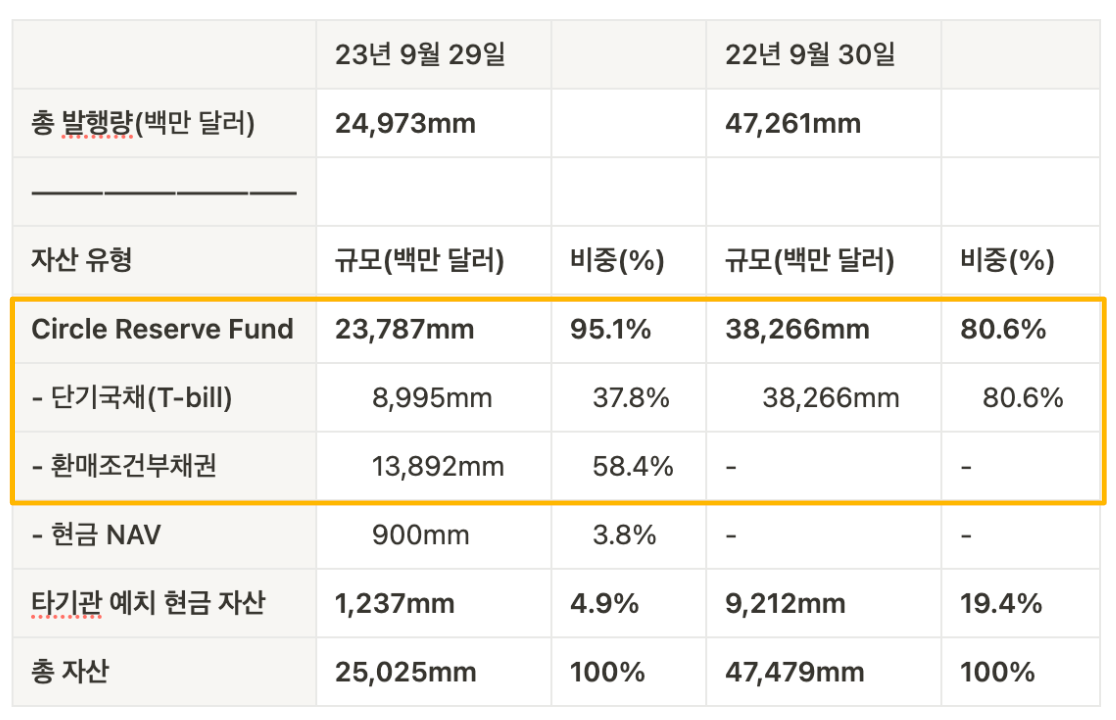
Source: Circle USDC monthly assurance and transparency report
Like USDT, USDC holds 80–95% of its assets in cash equivalents, though its repo-to-T-bill ratio differs slightly. In terms of business model, USDT and USDC share the same structure.
Revenue estimate:
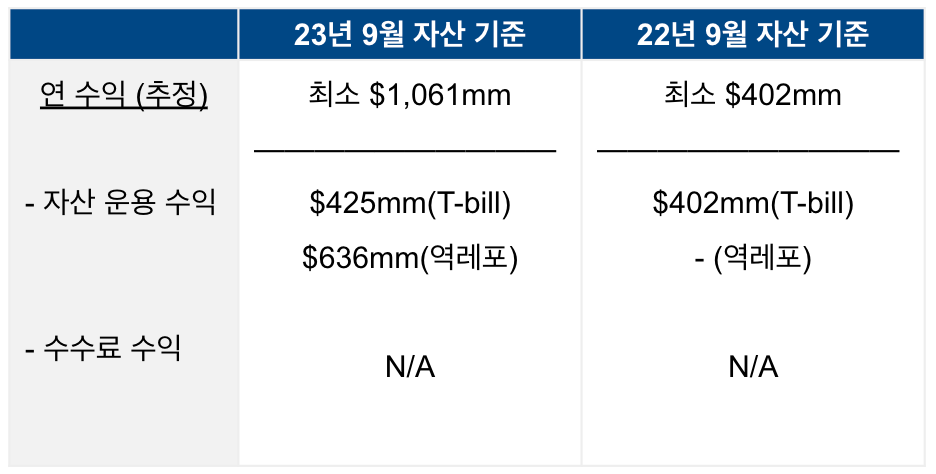
Source: Self-estimated from publicly available T-bill and reverse repo rates
USDC's revenue is likewise not transparently disclosed. USDC currently charges no deposit/withdrawal fees, so USDC's revenues consist entirely of asset management income. Using the same estimation method as Tether, I estimate Circle earned at least ₩1.3 trillion from USDC over the year to Sep 2023. Bloomberg reported Circle's H1 2022 revenue at $780 million — already exceeding its full-year 2022 revenue estimate. Although 2023 assets are lower than 2022 and the portfolio mix differs, the ₩1.3 trillion estimate doesn't seem unrealistic.
Conclusion: Circle manages approximately ₩30 trillion in USDC assets and earns a minimum of ₩1 trillion in revenue.
The existing banking sector's response to the crypto challenge — feeling both threat and opportunity simultaneously — is CBDC (Central Bank Digital Currency). Discussion of CBDCs began in academia and the private sector after 2015, initially limited to using distributed ledger technology for securities settlement and large-value payments. But Facebook's 2019 stablecoin project Diem became the catalyst that elevated CBDCs to a priority for central banks worldwide.
Over 100 central banks globally are currently in the experimental phase of developing and introducing CBDCs. CBDCs have an immediate practical advantage: no currency manufacturing cost (as seen in the BOK income statement). Conceptually, a CBDC is simply a central bank issuing currency in digital form — which differs from current currency circulation in three key ways:
China's e-CNY, reportedly the most advanced CBDC, pays no deposit interest to prevent money from concentrating in the CBDC. It also caps individual CBDC holdings and has commercial banks handle distribution — a form of market protection.
In some ways, the changes CBDCs could bring are disruptive — capable of shrinking the financial intermediation role that is the very foundation of existing banking and eliminating its revenue source. CBDCs were proposed by the traditional financial sector as a response to stablecoins and other crypto assets — but whether the sector can muster the political will to deploy something with this degree of self-disruptive force as a real offensive tool, rather than a defensive one, remains to be seen across the various countries experimenting with it.
Having traced the historically established roles, functions, and regulations of banking, analyzed current banks' business models via financial statements, and estimated the business models of stablecoins and CBDCs as entirely new possibilities enabled by blockchain technology, I'll close with observations on similarities, differences, and a forward-looking take.
Similarities: Market Liquidity Supply
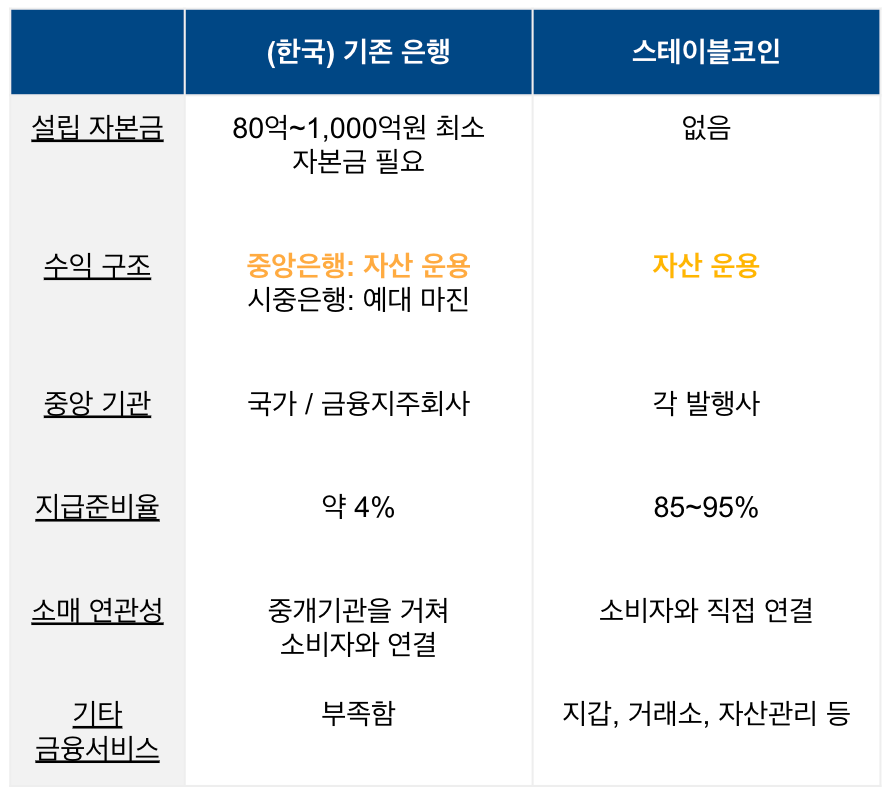
Both traditional banks and stablecoins share the function of supplying market liquidity. Central banks create "base money" through currency printing; through a cascade of commercial banks, this becomes "broad money." Simply put: the central bank prints ₩1 million and it passes to commercial banks, which hold only their reserve ratio in the vault and relend the rest — a process that repeats until ₩5–10 million circulates in the market. As of Sep 2023, Korea's base money is ₩265 trillion but broad money is ₩6,641 trillion — implying an average reserve ratio of about 4%.
Applying the same logic to stablecoins: as of Nov 2023, stablecoin circulation is $127.1 billion (approx. ₩165 trillion). With USDT and USDC's average cash asset ratio of 87%, treating that as a reserve ratio gives a broad-money multiplier of 1.14× — implying stablecoins supply approximately ₩188 trillion in broad money to the crypto market. Given that the crypto market was approximately ₩2,600 trillion in 2022, stablecoins supply roughly 7% of total market liquidity.
While each country's currency has a monopoly on supplying market liquidity, stablecoins supply only a portion of crypto market liquidity — under 10%. But if a higher reserve ratio means a more stable institution, stablecoins' 85%+ reserve ratio versus commercial banks' sub-5% reserve ratio suggests stablecoins are actually more resistant to bank runs than commercial banks.
Differences
The differences between traditional banks and stablecoins are summarized in the comparison table below. It clearly shows that stablecoins resemble central banks — not commercial banks — in structure, with an asset-management business model and a high reserve ratio.
Imagining the combination of blockchain technology and the banking business model, two new possibilities emerge. The first: blockchain technology means we can now create countries. From a natural formation perspective, a country is essentially a group of people using the same currency, developing through economic activity denominated in that currency. One crypto analyst noted that as of October 2023, stablecoins have become the 16th largest holder of U.S. Treasuries globally. Stablecoins are now compared on equal footing with sovereign nations in meaningful macroeconomic metrics. While this may seem like a mere data point, it sparks the imagination: stablecoins could be a powerful tool for introducing an entirely new concept of nationhood.
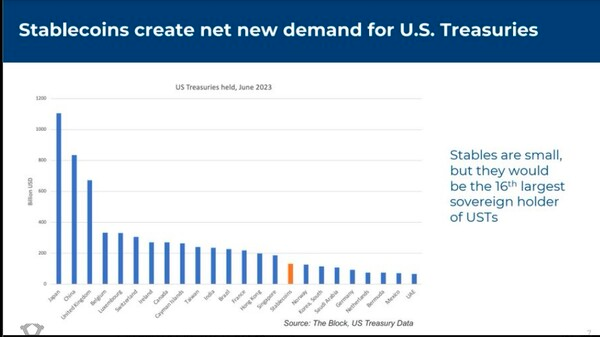
Source: The Block, U.S. Treasury Data
The second possibility: blockchain technology means we can now found a bank. As we've seen, USDT manages ₩100 trillion in assets and generates at least ₩4.5 trillion in annual revenue; USDC manages ₩30 trillion and generates at least ₩1 trillion. These were achieved in under 10 years (USDT launched 2014, USDC 2018) — impressive results. Looking globally at the most profitable companies — clustered in energy, IT, and banking — and pairing that with stablecoins' profitability and growth, it's reasonable to expect a stablecoin operator to crack this ranking in the near future.

Source: Forbes Global 2000, Statistica
Blockchain technology may change the world — or the existing system may prove more durable than expected. No one can know which future is coming. But examining similar historical episodes can offer a balanced perspective to close Part 1.
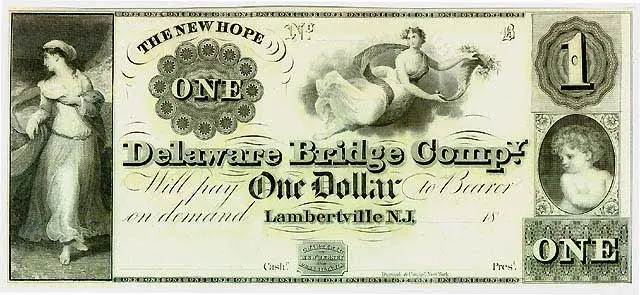
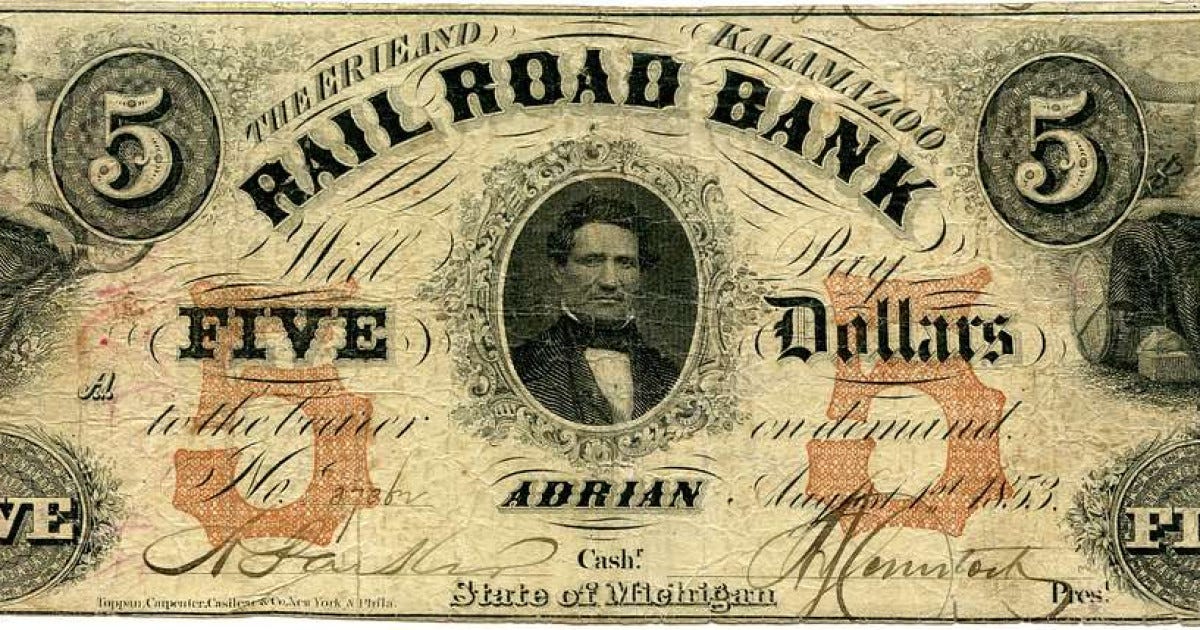
In recent history, the United States had a Free Banking Era (FBE) beginning in 1837. During this period, not just state-chartered banks but private banks could freely issue private banknotes backed by state-issued bonds. This era resembles today's private organizations issuing stablecoins — and it ended after just ~25 years with the National Bank Act of 1863, which created a national currency and imposed a 10% tax on transactions mediated by any other currency, achieving currency unification through centralized, coercive means.
Might stablecoins be a brief trend before fading? Or could they become borderless legal tender? It's fun to speculate.
The often-cited reason for the Free Banking Era's failure is that private banknotes couldn't satisfy the No-Questions-Asked (NQA) principle of money — the idea that money must be usable without any doubt about its value. During the FBE, private banknotes issued by different banks traded at various discounts depending on the issuing bank, region, and timing. This variability made the NQA principle impossible to maintain. The chaos was resolved through the National Bank Act — by centralizing, coercively, a uniform national currency.
Source: Wikimedia Commons
Source: Bunk History
Centralized currency unification may seem to contradict blockchain's emphasis on decentralization — but Harvard economics research found that the centralized national currency had real utility: regions where national currency circulated showed faster growth in tradeable goods production, lower tradeable goods prices, and higher total productivity and innovation compared to regions still using private currencies.
This history allows us to imagine two diametrically opposite future scenarios. The first: stablecoins become a global currency transcending borders, adding value to the real economy the way national currency did — potentially becoming the new monetary standard. The alternative: stablecoins, like FBE private banknotes, fail to maintain their value under external pressure and never clear the threshold of acceptance as money — becoming yet another currency that flashed brightly and briefly. I can't say with confidence which future is coming, but I find it thrilling to be living through an era when blockchain technology is opening the door to such new possibilities.
BusinessI wanted to understand why Chungmuro has so many print shops.
 Business
September turned out to be even more of a whirlwind than I expected, but as it drew to a close I sat back down to write. I knew if I let the month end without posting at least one Money Machine piece, I'd regret it when I looked back at my monthly post counts later.
 Business
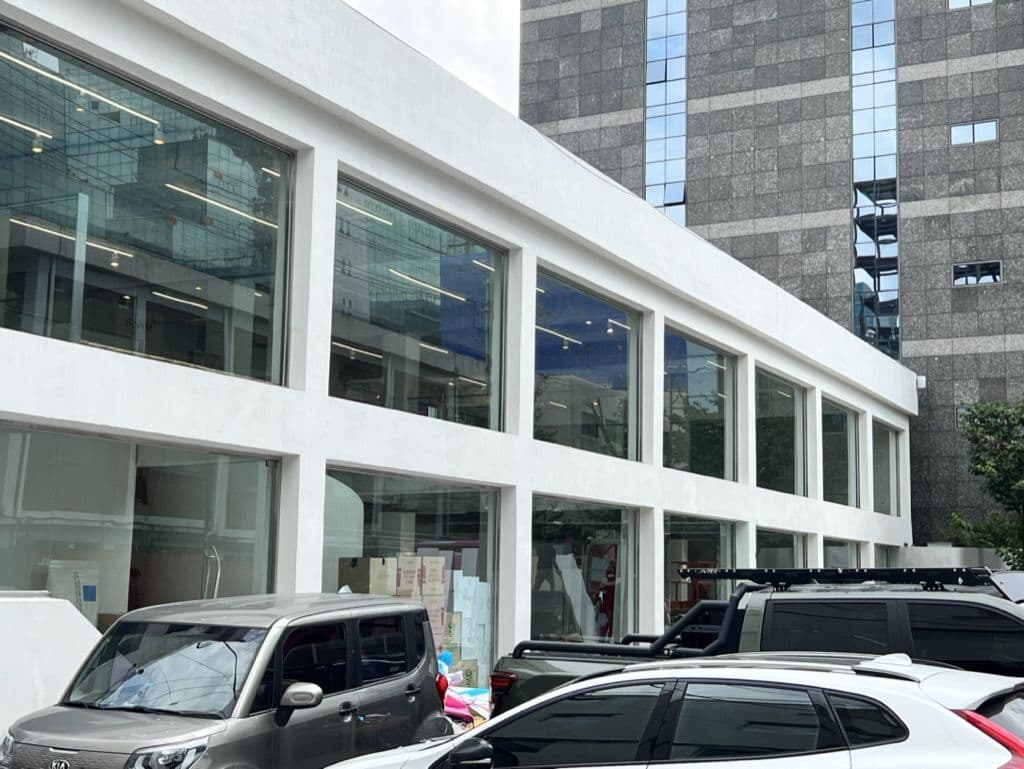
My company office is located right next to Seongsu Station, so I've been watching Seongsu's transformation every day for about two years. One of the things that makes this dynamic neighborhood special is how many pop-up stores it has — new ones appear and disappear every single day. Seeing a lot of pop-up store rental listings in real estate windows lately made me curious about their profitability, so I took a closer look at Scène, the pop-up space closest to me.