September turned out to be even more of a whirlwind than I expected, but as it drew to a close I sat back down to write. I knew if I let the month end without posting at least one Money Machine piece, I'd regret it when I looked back at my monthly post counts later.
Introduction
I recently had the chance to meet someone running a large grain, rice, and tteokbokki rice cake business in Iksan, North Jeolla Province, and spent some time thinking together about how to take cup tteokbokki overseas. I asked around and did some research into whether cup tteokbokki could be independently distributed as a standalone brand in India, Vietnam, or the US, but came to realize that solo distribution of a single cup tteokbokki brand is not a simple undertaking. So I thought harder about where this company's true competitive advantage lies, and concluded it's the ability to source and process high-quality grains and rice. The business that could actively leverage this strength to create added value, I thought, was the tteok business — and that led me to wonder: just how much can you make from tteok?
😋 Personal Memories of Tteok
Thinking back to times I, as a consumer, went out of my way to seek out tteok or had particularly meaningful experiences with it:
- In high school, the yeongyang-tteok (a.k.a. Gongju-tteok) I ate as a breakfast substitute: my mom would handpick the finest chestnuts and beans, bring them to the tteok shop herself, and ask them to customize it — less sticky rice, packed full of fillings. I have vivid memories of skipping the school cafeteria meal to save time, eating yeongyang-tteok instead (possibly even more than a full cafeteria serving?!).
- The 100-won honey tteok marketing case from Market Kurly (Daegu Honey Tteok): in substance it's just a mochi-style glutinous rice cake dipped in honey sauce — yet they made it sound so delicious and priced it at 100 won as a hook. I remember it as a marketing success story that made me genuinely admire the craft.
- The omegi-tteok I always bring back from Jeju: every time I visit Jeju Island, I return loaded with omegi-tteok like someone bringing home hometown specialties after a holiday — it's a rule. The handmade, visibly oversized omegi-tteok from the traditional market beats anything machine-made.
- The black sesame tteok my mom would travel to Apgujeong for: my mom, who walks everywhere to find good food, had rarely made a special trip just for tteok. But starting last year she began stopping by whenever the craving hit — for black sesame tteok from a specific place. One taste and I understood immediately.
Some people don't like tteok, but most Koreans probably have at least one tteok memory.
🍡 Three Models for the Tteok Business
1. The Franchise Model — Bijun & Tteokbo-ui-haru
Bijun
When I think of tteok franchise brands, Bijun comes to mind first. I've always found tteok cake personally fascinating as a product. Looking into it, Bijun is a tteok café franchise launched by SPC in 2006. As a franchise business, many people have written analyses of its startup economics — the key points I noted are:
- In 2021, average annual revenue per Bijun franchisee nationwide: 160 million KRW
- Food cost ratios by category: cake items 65–70%, semi-finished/finished items 55–60%, coffee/beverages 27–50%
(The cost ratios suggest tteok cake is more of a differentiating marketing product than a profit driver.)
- Labor costs: approximately 10–15% of revenue
- As one of SPC Group's brands, standalone financial data for Bijun alone wasn't available
Tteokbo-ui-haru
Bijun was the first tteok franchise brand that came to my mind, but investigating it revealed less that was interesting than I'd expected — probably because it's a large corporate brand from SPC, and there's no founder story or individual narrative that resonates. Tteokbo-ui-haru, by contrast, started Korea's first tteok franchise and was independently founded, making it a more interesting case to examine.
'Tteokbo-ui-haru' is the brand name; the actual business is split between Tteok-pa-neun-sa-ram-deul (People Selling Tteok), which handles tteok manufacturing and franchise operations, and Tteokbo-ui-haru, which operates as a retail business buying tteok from the former. Tteokbo-ui-haru's revenue scale (9.4 billion KRW) is too large to be a single tteok shop — I suspect the revenue from directly-managed locations run by the major shareholder and from stores that can't be opened as franchises for various reasons may all be consolidated here.
Fortunately, the audit report for Tteok-pa-neun-sa-ram-deul is publicly available, so I reviewed three years of cost-revenue structure.
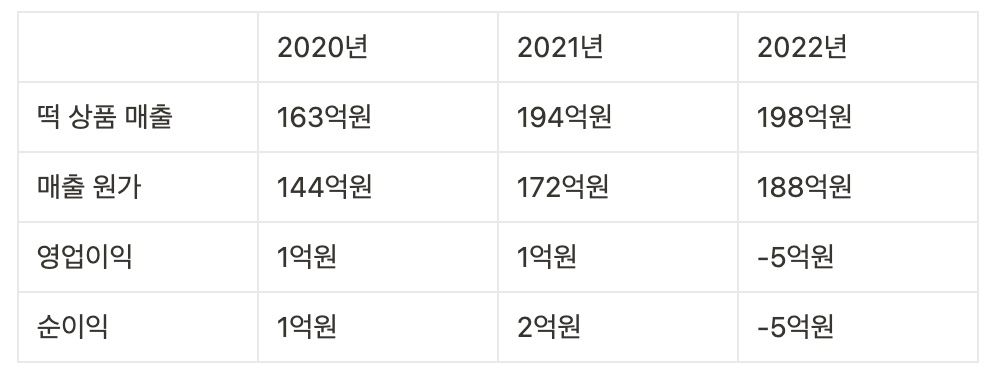
Tteokbo-ui-haru's franchise count has been growing slowly: 148 (2020), 151 (2021), 154 (2022). Looking at financials alone, while the top-line is growing, the profit picture appears to be worsening. It seems like a moment when a momentum turnaround is urgently needed. Extreme options would include looking for opportunities overseas, like frozen gimbap did, or developing the kind of mega-hit tteok product described below.
2. The Mega-Hit Product Model — Apgujeong Gongju Tteok & Baengnyeonhwapyeon
The mega-hit success model is really the protagonist of this post. When I first tasted Apgujeong Gongju Tteok's black sesame injeolmi, I thought of it as just one of many pilgrim stops on a tteok tour — but learning the revenue scale and the story behind it made me genuinely admire it as a case of success through quality and tenacity.
Apgujeong Gongju Tteok
Apgujeong Gongju Tteok has a very long history and a genuinely fascinating founding story — it's somewhat detailed, but I want to share it. I drew primarily from a Joongang Sisa Magazine interview article.
- Apgujeong Gongju Tteok is the Seoul branch of Gongju Tteokjip, which was started in Daejeon in 1965 and opened its Seoul location in 2000. Gongju Tteokjip was famous for its yeongyang-tteok — a chestnut and jujube nutritious rice cake that became popular as a breakfast substitute — but today Apgujeong Gongju Tteok is better known for its pitch-black sesame-covered black sesame injeolmi.
- In 1965, the founder of Gongju Tteokjip was a grandmother named Park Ok-bun, originally from Gongju. Feeling that the family couldn't all make a living in Gongju, she gave her husband the money from selling fabric at the market and told him to establish himself in a major city — Seoul, Daejeon, or Busan. Her husband found his footing and eventually brought the whole family to Daejeon, which is how Gongju Tteokjip began.
- Knowing a generic menu wouldn't be enough to survive, she successfully developed and commercialized yeongyang-tteok in 1995. Yeongyang-tteok is glutinous rice cake packed with nuts and seeds like chestnuts, jujubes, and pine nuts — available in many varieties depending on the main ingredient (mugwort, pumpkin, black rice, red bean paste, sesame), and excellent as a meal substitute. This tteok, known as 'Gongju-tteok,' was essentially Park Ok-bun's patented specialty. Her eldest son-in-law Joo Kyung-hyeon proudly called it "a venture product that opened a blue ocean." After opening the Seoul branch in Apgujeong, the phone line was 'paralyzed' for the first five years from orders for just the Gongju-tteok.
- Apgujeong Gongju Tteok has been expanding its real estate holdings on the back of strong cash flow. In 2015 it purchased a building in Sinsa-dong, Gangnam for 8 billion KRW, and the following year acquired an additional building worth 15.9 billion KRW. While the company borrowed 15.2 billion KRW for the acquisition, it repaid 3 billion KRW in the last year alone, with plans to fully repay the debt within the next three years.
- The majority shareholder of Apgujeong Tteokjip is CEO Joo Kyung-hyeon (31%), eldest son-in-law of founder Park Ok-bun. His wife Bae Mi-sook holds 20%, Joo Hyun-woo 30%, and Joo Da-eun and Joo Ye-eun each 9.5%.
Knowing this historical story and then looking at the financial results below, you can't help but wonder if these numbers are actually possible from a single tteok shop.
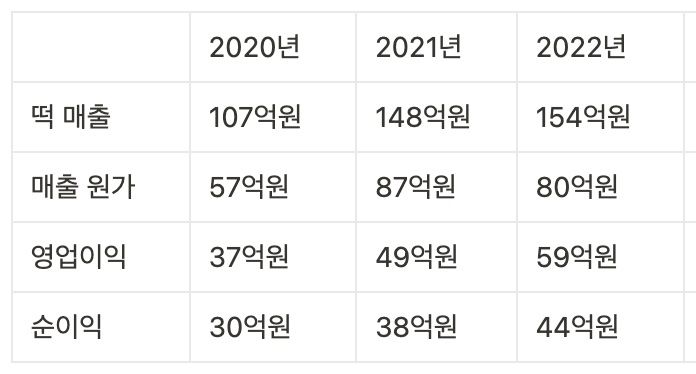
- According to the income statement, the cost ratio ranges from a minimum of 52% to a maximum of 65%
(Similar to Bijun's cost ratios — it seems there is a natural cost ratio range for tteok as a product.)
- Operating margin surged from the low 20s to the high 30s coming out of COVID (likely around the time annual revenue crossed 10 billion KRW)
- This implies 1,000 customers buying tteok consistently for roughly 360 days a year
- To make the 2022 tteok revenue of 15.4 billion KRW tangible, I simplified as if it were entirely from black sesame injeolmi sales:
- In 2022, 1 kg of black sesame tteok was 17,000 KRW — dividing that into annual product revenue, roughly 906 tons were sold in a year
- That's 2,500 kg of tteok sold per day; assuming most customers buy 1 kg on regular days but 4–5 kg during holidays, I assumed a per-purchase average of 2.5 kg
- The result: 1,000 customers purchasing daily for 360 days — and assuming 18 operating hours per day, that's 55 customers buying tteok every hour
Apgujeong Tteokjip's revenue and profit structure is genuinely astonishing, so I analyzed what I personally felt to be the product competitiveness of the black sesame injeolmi as follows: (a.k.a. black sesame tteok appreciation time!)
- An extraordinary amount of sesame coating — so much that you might genuinely mistake it for asphalt
- The coating is moist and well-bound, so there's no risk of choking on dry powder
- The sweetness level is just right
- The black sesame is beautifully roasted — nutty flavor without any beany aftertaste
- (Back to basics!) The injeolmi chewiness is perfect — it tears cleanly and has just the right amount of pull
- Sliced to bite-size pieces — almost resembles artisan chocolates in appearance
I initially assumed all injeolmi would be roughly the same, but listing out these competitive elements made me realize it would take enormous experimentation and operational capability for a competitor to replicate all of them ^^;;;
Baengnyeonhwapyeon
Curious whether Apgujeong Gongju Tteok was the only tteok shop to grow big on a single hit product, I searched and found Baengnyeonhwapyeon. Key facts:
- Built a fanbase of over 200,000 loyal customers with an innovative product: the bap-al-chapsal-tteok (grain-textured glutinous rice cake)
- 2019 revenue: 10.619 billion KRW
- The flagship bap-al-chapsal-tteok's strongest competitive advantages: domestic ingredients yet affordably priced via direct farm sourcing and automation, and a 'bread-like tteok' with a distinctive rice grain texture that's hard for competitors to replicate
- The building was originally a Korean full-course restaurant called 'Geumbal,' opened in 1996. But guests liked the tteok served as a dessert more than the main dishes. So they started selling it at 10,000 KRW for 10 pieces — and that's how it began. Then the owner's son, who majored in business administration, suggested that 'traditional tteok probably has strong potential for success,' came up with the business idea, and in 2007 they created the Baengnyeonhwapyeon brand. They initially ran the Korean restaurant and tteok shop side by side, then in 2014 closed the restaurant to focus entirely on Baengnyeonhwapyeon.
- Touring bakeries across the country, they noticed that roughly half of popular products contained red bean paste — so they tried putting that in tteok too, which turned out to be a massive hit.
- Made using the old-fashioned method: cooking glutinous rice into sticky rice, then pounding it in a mortar. The intact rice grains burst in your mouth, releasing the nutty sweetness of glutinous rice — that texture is what makes it special. Commercial red bean paste typically has high sugar content and additives to extend shelf life, but Baengnyeonhwapyeon's red bean paste reduces shelf life to 2–3 days and minimizes sugar with no chemical additives. Individual packaging also makes it convenient to store and eat.
- The production space is barely over 60 pyeong (approximately 200 m²), yet on holidays daily revenue surpasses 100 million KRW. Annual revenue was only 500 million KRW at the start, then grew 50% per year. Word of mouth alone brought more than 200,000 registered members to the Baengnyeonhwapyeon website.
- This scale of revenue in this space would be impossible with human hands alone — over 60% of the process from steaming tteok to automatic packaging has been automated.
3. The Online Distribution Model — Yeong-eui-jeong
Yeong-eui-jeong is another company I came across in my research. Unlike a typical tteok shop, it feels like a company that took a more business-minded approach from the start. It's interesting that they moved toward overseas expansion first under the 'Korean' and 'traditional' keywords.
- They produce virtually all traditional tteok varieties familiar to Koreans: gyeongdan (rice balls), chapsal-tteok, yakbap, injeolmi, jeolpyeon, and even ceremonial tteok for weddings. Their standout popular products are ssuk-ojengyi-tteok (mugwort rice cake) and omegi-tteok.
- Fusion tteok varieties are also diverse: corn cream cheese tteok and strawberry cream cheese tteok — with cream-filled interiors — are especially popular.
- 99% of the tteok Yeong-eui-jeong produces and sells is frozen. They chose the frozen format so consumers can store and eat it conveniently.
- First year as a corporation in 2004: revenue approximately 700 million KRW; 6 billion KRW in 2010, 9.25 billion KRW in 2015, 9.8 billion KRW in 2020 — a steep growth trajectory.
- Starting with the US in 2015, they now export approximately $600,000 annually to Australia, China, and others. Cumulative exports reached $3 million as of June 2021, and they are currently exploring European market entry.
Export revenue still appears small, but the emphasis on developing fusion tteok and frozen tteok suggests a growth story somewhat different from Apgujeong Gongju Tteok's — worth watching.
🗺️ Closing Thoughts
I didn't expect a Money Machine post about tteok to run this long. As always, the more closely you look at any corner of the world, the more there is to learn.
The biggest question I found myself asking while looking at successful tteok businesses was: how do we explain Apgujeong Gongju Tteok's overwhelming performance? All the companies cited here are genuinely excellent businesses generating annual revenues over 10 billion KRW. But seeing that a company like Apgujeong Gongju Tteok — and Baengnyeonhwapyeon — has better economics than franchise brands (often called the crown jewel of the food industry), and that they're outperforming Yeong-eui-jeong despite its active frozen tteok technology development and overseas push, taught me just how important a mega-mega-hit product truly is.
Tteok sales can also benefit Korea's economic structure: the tteok manufacturing industry accounts for the largest share of the entire rice processing industry (26% as of last year), and the rice processing industry accounts for 18.8% of total rice consumption — rice farming and tteok are inextricably linked. Personally, I love the texture of tteok, and just as frozen gimbap hit big in the US recently, I always wonder whether tteok might have a similar opportunity. If a globally mega-mega-hit tteok product emerges in the future, re-reading this post will be a pleasure!
 Business
 Business
 Business