 Book
Book7 min read
Thoughts on <DO HUMANKIND'S BEST DAYS LIE AHEAD>
amid these days so full of AI-driven FOMO, to consider what kind of future for humankind we ourselves hope for.
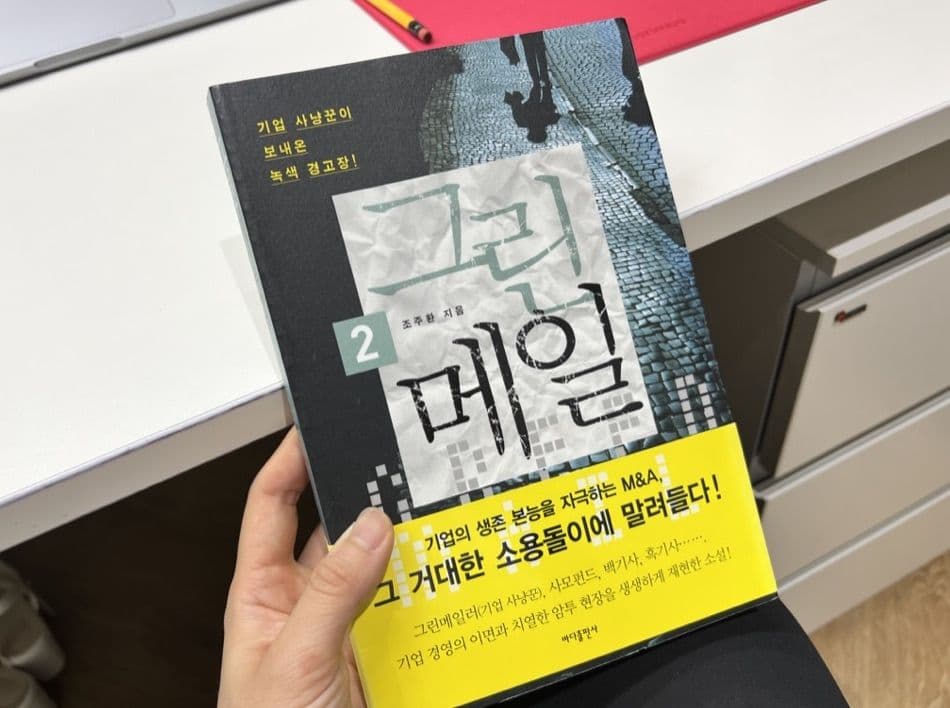
I was in the middle of looking for good books about 'currency' and 'money' when I came across a blog recommending Greenmail and added it to my reading list. One day while browsing an Aladin used bookstore, I was looking through my wishlist when I found both Greenmail 1 and Greenmail 2 shrink-wrapped and in pristine condition — so I snapped them up immediately.
In truth, this book had sat on my desk for a long time before I recently felt a strong urge to read it. It's probably because over the past few years at work, I've heard a lot about 'listed company M&A, buyouts, and private equity.' Until quite recently, I had known nothing about 'corporate raiders' or 'greenmail.' Looking it up, I found that 'greenmail' refers to the practice of buying a large stake in a listed company, threatening management with a hostile takeover, and then forcing them to buy back those shares at a premium above market price in exchange for abandoning the takeover attempt. It's often said that the line between a corporate raider and an M&A specialist is razor thin. Through this book — fictional, but a vivid recreation of the world they inhabit — I was able to experience the world of M&A in a genuinely engaging way. If you're looking for something that satisfies both the pressure to read productively and the desire to enjoy a good story, I'd recommend Greenmail, which opens with "A green warning letter from a corporate raider!"
Since this is a novel, I'll avoid writing about the plot or characters. Before I even started reading, I was intensely curious about what kind of person the author was. The book introduces the author as follows:
At the age of twenty, he became the owner of a listed company through M&A. He has directed the restructuring and mergers and acquisitions of more than 50 companies across manufacturing, finance, and services. He is currently the Korea representative of API (Asia Pacific Investment), a Hong Kong-based private equity fund managing a Canadian pension fund, and the CEO of investment company Next Value. He is currently focused on large-scale project investments by combining overseas private equity funds (PEF) and hedge funds with domestic funds to form matching funds.
I was surprised to learn he wasn't a professional novelist, and also surprised that an investment industry expert known for being extremely busy had found the time to write a book. I was so curious about how author Jo Juhwan had lived his life that I searched for him, but found less information than I expected.
Jo Juhwan, CEO of Next Value — background
I searched under all three keywords — API Hong Kong private equity, Next Value, and SecureSoft — but that was essentially the entirety of the information I could find on author Jo Juhwan. Since a novel, no matter how vivid, is a fictional world, I had hoped that knowing more about the real life the author has lived would add even more value to the book. I wasn't able to learn much about him now, but if I come across more facts related to this book over time, I think that would be genuinely exciting.
That said, even the little I found searching for him helped me understand the book better. The author explained that in the fall of 2006, he bought 30% of a company's shares and filed for a court injunction to suspend management, but when the judge sided with the controlling shareholder who held a 10% stake and dismissed the claim, he decided to write Greenmail. Knowing this backstory made it clear why the author set one of the novel's protagonists — 'Nikos Holdings' — as simultaneously a corporate raider and an M&A specialist who restores justice. For those who read this post before reading the book: I hope you'll enjoy the added pleasure of discovering and understanding why the author built in the elements and structure he did.
As the author's motivation for writing makes clear, Korea has held nightmare memories of 'hostile M&A' since the IMF crisis. But true M&A specialists have also achieved the kind of turnarounds that read like mythology. This raises the question: what is the line between a corporate raider and an M&A specialist? My tentative answer, after reading this book, is that the difference lies fundamentally in the original intent behind the acquisition. But 'intent' is something that can't easily be assessed before events unfold and results emerge. Even so, I think you can form an intuitive judgment: when you imagine what the acquired company looks like at the final destination — will only the raiders be smiling, or will the company's stakeholders be smiling alongside them?
Just as people's lives move through various stages, so do the stories of companies. Among all those stages, M&A is where sharp competing interests and extreme strategies collide — you might compare it to the period in a person's life when they're at their most energetic and striving to perform at the very highest level. Thanks to this book, from now on whenever I learn about a company's M&A story, I expect I'll be able to picture it much more vividly in my mind.
Bookamid these days so full of AI-driven FOMO, to consider what kind of future for humankind we ourselves hope for.
 Book
Book Book
BookAs I've been getting more into tennis lately, the book <The Inner Game of Tennis> that I read about two and a half years ago came back to mind. When I first read it, I didn't know much about tennis, so I felt like I only understood about 30% of its message. Even so, the book's message about "relaxed concentration" was helpful for life in general — and with renewed passion for tennis, I was curious how differently it would resonate the second time.