 Book
Book7 min read
Thoughts on <DO HUMANKIND'S BEST DAYS LIE AHEAD>
amid these days so full of AI-driven FOMO, to consider what kind of future for humankind we ourselves hope for.
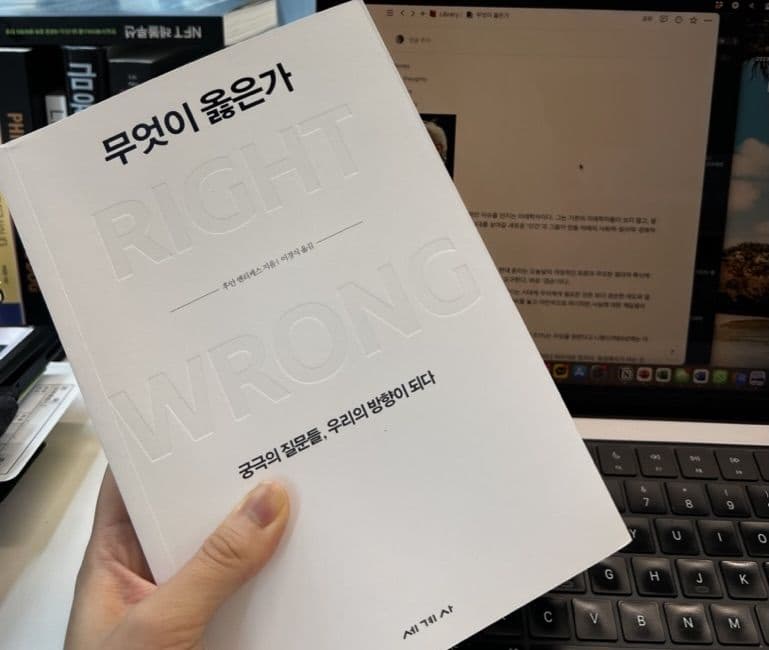
I first came across <Right/Wrong: How Technology Transforms Our Ethics> through a conversation with a friend where we were sharing what we'd each been reading lately. Though they gave only a brief summary, I knew immediately I had to read it — because of questions I'd been wrestling with a lot recently. My current areas of interest include artificial intelligence, blockchain, cryptocurrency, private equity, and venture investment. Following developments in these industries, I've come to feel that things I consider wrong are happening, and that many proposed solutions to those problems are also wrong. Thinking along these lines, I suddenly noticed I was becoming too rigid in my sense of right and wrong. I believe that the more stubbornly entrenched one's own sense of righteousness becomes, the more it signals aging — so this was something I took quite seriously. I hoped this book might put the brakes on that stubbornness.
This book explains, through statistics and case studies, how people's ethical judgments of right and wrong shift as the times change. Below I've excerpted the passages from each chapter that struck me as the most powerful questions or food for thought, adding my own reflections along the way.
Discriminating against gender identity is as foolish as discriminating against left-handedness. If being gay were the result of individual choice, the proportion of gay people would vary across countries with different cultures. In reality, the distribution is proportional to regional population sizes worldwide.
One reason we desire to redesign humans (using biotechnology) is that humans are uniquely far from diversity. The fact that the genes of nearly 8 billion people worldwide are almost identical reflects that not long ago, the human species nearly went extinct — out of more than thirty kindred species, only one survived: us. As descendants of a single surviving African ancestor, we are highly vulnerable to dramatically dangerous infectious diseases and could go extinct at any time. It is very rare for a single species to have such enormous population while also being spread across the entire globe.
Since reading , when I reconsider things that society takes for granted, I've thought that many of them are rules we chose as biological organisms in order to survive. Dietary restrictions in religion and prohibitions against same-clan marriage were rules necessary for human survival in an era before technology had advanced.
Abundance potentially makes us far more generous and ethical toward others, and instills a sense of public morality. We can be generous without going hungry or giving up much. This is because the total amount of what we already possess is so large.
As (IT) technology accelerated our ability to verify and prove facts, we became paradoxically flooded with deliberate disinformation and lies. Technology has changed the nature of truth. Hitler explained this in Mein Kampf as follows: "There is always a certain force of credibility in the big lie. The broad masses are always more easily corrupted in the deeper strata of their emotional nature... they more readily fall victims to the big lie than the small lie... it would never come into their heads to fabricate colossal untruths, and they would not believe that others could have the impudence to distort the truth so infamously."
What Hitler described about lying is frightening, yet I could only nod in agreement. It applies not just to society and the masses, but to small-scale groups as well.
We must properly understand the ways in which so many people participated in, protected, and spread that horrific practice of slavery. Otherwise, we won't realize that we are quietly tolerating things that our descendants will condemn as completely immoral.
The history of slavery is one extreme example showing that even an ethic sanctioned as legal in society can change over time. Emerging technologies give us multiple choices, and in turn we will come to embrace, with broader and warmer hearts, those we've long considered "others" — and thus the morning of enlightenment slowly dawns.
The book notes that the abolition of slavery began in Britain following the Industrial Revolution. I came to think that for us to create a history we need not be ashamed of, technology and ethics need to evolve together dynamically.
Scholar of religion Karen Armstrong, once a nun, spent her lifetime focusing on the commonality of religions worldwide, arguing that all major religions are grounded in a single principle: "At the heart of every religion, ethic, and spiritual tradition is the principle of compassion. It is the Golden Rule: always treat others as you would wish to be treated yourself."
As more personal information becomes public, will we become a more open and tolerant society, or a more restrictive society dominated by strict moral judgment?
Baumol's cost disease: a sector where productivity barely improves over time, but costs consistently rise (e.g., musicians, healthcare workers, public school services).
Prison services are profitable. Local sheriffs receive $25 per day per inmate from state government. Some telecom companies charged prisoners $25 for 30 minutes of calls. Between 1880 and 1904, the Alabama state government covered as much as 10% of its budget from income earned by leasing out inmates.
Through a behavioral economist's study using Monopoly — a game manipulated to mimic capitalism — people with relatively more money were on average more likely to behave narcissistically, as though they were someone great. Players who started with more resources tended to believe they were naturally entitled to such advantages, and in many cases behaved less ethically.
The book connects this finding to the current issue of illegal immigration. It was a passage that made me watchful about whether I myself behave narcissistically about the nationality, parents, and circumstances I was given — things I never chose.
Excessive procedure kills. — A person at the FDA focused solely on safety can appear to be protecting public health. But this good guy can also kill people by doing nothing.
There were two Lyme disease vaccines with efficacy of 76–92%, and no serious side effects whatsoever. But due to vaccine refusers and insufficient profit, both products were discontinued within three years, after which 300,000 people contracted Lyme disease annually.
Reading this, I felt a sudden surge of fear. I was struck in particular by the fact that there are countless intractable problems in the world that no single person can resolve, and that these problems affect individuals' lives and deaths. Because advances in technology and science are the product of knowledge accumulated by all of humanity, not by individuals, this example deepened my understanding of why society as a whole — rather than a single genius — must continuously strive toward what is ethically right.
The cost of mistakes, rash action, or lack of oversight can be easily measured. But measuring the cost of something held back, or something never developed at all, is far more difficult.
I fully agreed with this, and it naturally recalled something I read in . The public holds in high regard those who solve problems, but is far too ignorant of those who prevented the problems from arising in the first place. That book asked: many political stars emerged in the aftermath of 9/11, but if there had been someone who prevented those attacks from happening — would that person now be a hero in our society? The realization that a society which assigns greater value to prevention is a more mature society stayed with me.
Fear commonly incites cruelty. When seized by fear, it is difficult to open one's heart generously to past events, to people with different opinions, or to rapidly changing circumstances.
The one thing I am currently certain of is that I do not have all the answers.
Apply tolerance when understanding people within the context of their past era; but if someone is still keeping slaves today, you must not apply the same standard used to judge 18th-century slaveholders. People living in the modern age presumably know much more — shouldn't we hold them to a stricter and more exacting standard?
Even in the death camps of war, there were horrifyingly evil guards, and on the other hand, there were also guards who were considerably humane.
This passage reminded me of something a friend once said about what they found interesting when reading history books. History isn't just made up of grand dramatic events — bridges destroyed by artillery, surprise attacks in the dead of night — but if you zoom in on any one individual and imagine their daily life, they were also eating meals, having children, arguing with friends, confessing their love to someone. Just as history looks different depending on angle and context, so too does ethics — perhaps what we need is "humility."
The author asks an amusing question: You need to urgently find a babysitter for your newborn, and there are exactly two to choose from: Obama or Trump. Which one do you choose?
I found this delightful. It suggested that, more intuitively than we might expect, we can judge on common sense grounds who possesses good virtues.
In the way we treat each other, let us not be bound by the laws or religious standards of any particular era. Instead, let us place at the center such core principles as simplicity, generosity, empathy, courtesy, humility, compassion, civility, and honesty.
This is not a book the author wrote with a tightly structured argument to reach a particular conclusion. Instead, it carries the author's desire to convey a message and inspire change in readers. In truth, while reading, I felt frustrated after each chapter because the author would raise questions and offer various statistics and facts, but would then close each chapter without answering those questions — leaving things unstructured in my mind.
Yet now, when I recall this book, the first thought that comes to mind is that it is a warm book. The message that what we truly need today is not reckless certainty but "humility" grew more resonant with each page. The author's witty jokes along the way gave me moments to relax the tension in my furrowed brow as I pondered, "So is this ethically right or not?" And one good way of thinking this book gifted me: when reflecting on any ethical issue of the current moment, ask yourself — "How would my grandchildren's generation evaluate this situation?" Just as self-objectivity is an important virtue of leadership, in this rapidly changing era, perhaps we need a kind of generational objectivity: the ability to think across generations.
On the whole, as I mentioned in the introduction, if you have wrestled with similar questions about yourself growing too stubborn, this is a book I'd recommend reading on a summer vacation.
Bookamid these days so full of AI-driven FOMO, to consider what kind of future for humankind we ourselves hope for.
 Book
Book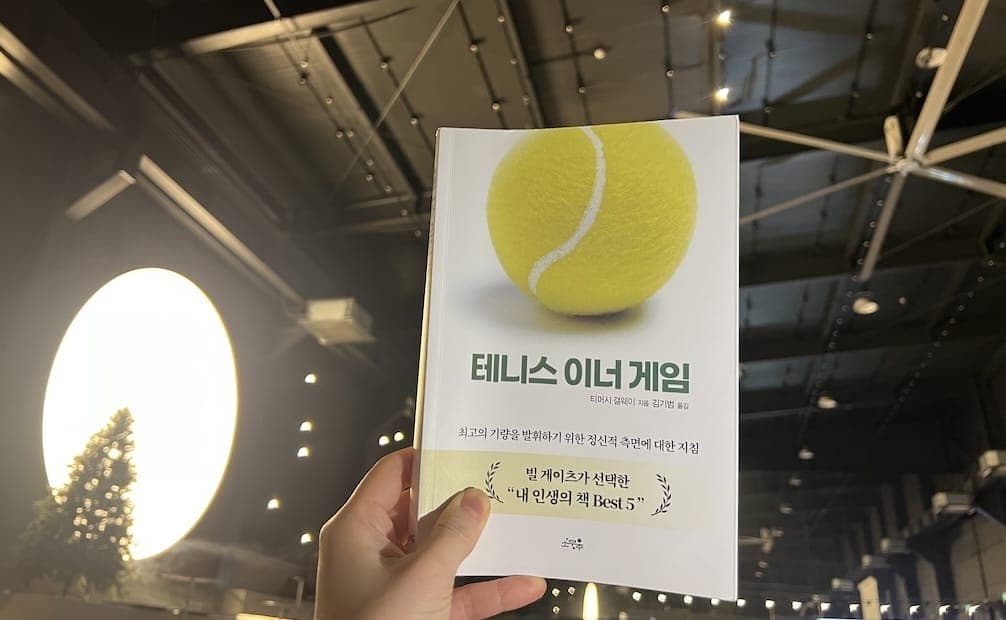 Book
BookAs I've been getting more into tennis lately, the book <The Inner Game of Tennis> that I read about two and a half years ago came back to mind. When I first read it, I didn't know much about tennis, so I felt like I only understood about 30% of its message. Even so, the book's message about "relaxed concentration" was helpful for life in general — and with renewed passion for tennis, I was curious how differently it would resonate the second time.