Opening
Around the time I was beating myself up for failing to keep up with my reading goal for the year, a friend surprised me with this book, saying they wanted to recommend it. I didn't feel like I could put this one off with the usual excuse of being busy — and more than anything, I was curious what kind of book a friend whose advice and support I value so much would recommend. So I read it quickly.
This was my first time learning about this book, but when I looked up the author, I found out it had already gained quite a word-of-mouth following in Korea since 2023. In some ways it's a formulaic self-help book, but it has the advantage of being argued more persuasively through the lens of psychology. It's also a guide to shifting your perspective through your "future self" to understand how to change your present.
About the Book
Since I've always enjoyed self-help books, much of the content felt familiar — things I'd read or heard at least once before — so it was an easy read. Some ideas overlapped with things I'd held consciously or unconsciously, just expressed differently, which made me reflect on how I'd been forgetting these things along the way. I've compiled below some "different words, same meaning" concepts from the book that stand out to me right now.
- You must dream big.
- I remember a teacher telling me when I was young: "It's better to be the tail of a dragon than the head of a snake." I agreed with that and have lived by it. This book also argues that bigger goals are actually more likely to be achieved than smaller ones. The logic is made more explicit here: an audacious dream has fewer paths to achieve it — and because of that, you spend less time agonizing over which method to choose, and fewer excuses arise. You end up fully committing to one of those few methods, which paradoxically makes it easier to achieve.
- You must believe in the compounding effect.
- This concept appears under many names — the butterfly effect, the multiplication principle, and more. Whether in a good direction or a bad one, once placed on a timeline, the results compound — this is a truth of the world that I think we must always keep in mind when making decisions.
- Lately, people often half-jokingly say, "Let tomorrow's me handle tomorrow's problems."
- After reading this book, I felt like I shouldn't even think this way as a joke.
- R=VD: The more vividly you dream, the more it becomes real.
- I learned the R=VD (Realization = Vivid Dream) concept in a self-help book I read in high school, and there was a period when I believed in it almost religiously. At the time, it felt like a magical sentence full of hope. But at some point, I felt like its meaning had been diluted — as if anything you wish for will come true — and people would just write something 100 times a day and stop there. I gradually forgot about this idea. But this book, drawing on psychology research, reinvigorates the concept more persuasively. When you vividly picture yourself already having achieved what you want — to the point where you feel like you already are that future version of yourself — the things you say, think, and do naturally rise to that level, and the results change. It's not simply that clasping your hands and praying makes everything come true; rather, shifting your perspective enables the actions that create change.
- "If my one-year-future self traveled back in time to see me right now, what would they say?"
- This question is, personally, the most practically useful thing I got from this book. The question "What are my goals one year from now?" is overused and keeps the subject anchored in the present me, making it hard to empathize with the future self. But flipping the perspective — imagining what my future self one year from now would say to the current me — reveals things I'd regret not doing and brings out a genuine urgency not to be ashamed of myself. In particular, one example the author gave resonated deeply: "When I imagined my future self 20 years from now traveling back to this moment, my child waiting for me to come home from work — as they always do — felt as precious as someone I hadn't seen in 20 years." It didn't feel like mere wordplay; I could genuinely imagine feeling exactly that way.
Beyond reinforcing these existing ideas, there are also many phrases from the book I want to keep returning to.
Underlined Passages from the Book
- To become your future self, you don't just need to "try" — you need to fight for it with everything you've got.
- Jeff Bezos created the "regret minimization framework" for his best decision-making. For any important decision, he asks himself: will I regret this on my deathbed?
- Jeff Bezos encouraged Amazon employees to write "future press releases" — looking at current products and projects from the perspective of a future customer to determine what truly matters.
- "Theory of Constraints": Step-by-step or small goals don't actually help. There are countless ways to achieve a small goal, so no single method carries enough weight. When you think about a dream that's 10 times bolder, everything you currently do gets filtered far more ruthlessly. And then you end up 100% committed to the methods that survive that filter.
- "Consistency Principle": People want to appear consistent to others. Because of this, you can fall into the trap of keeping your future self consistent with your past self. If you truly dream of a future self that seems impossible, it will absolutely look nothing like who you are today. Breaking that consistency requires enormous commitment and courage.
- Setting goals that are active, long-term, and rooted in love is the path to a successful and happy life.
- The core of the future self is: "Start with what you want and work backward."
- Chapter 1: 7 Threats to Your Future Self
- It is human nature that we can only survive when we have hope (expectation for the future).
- Where there is hope, there is always a way. Hope doesn't calculate the odds.
- Believe in your own agency. If you believe you have agency, you control your actions. You think actions matter and can influence the outcomes of your life.
- Interpreting the past negatively means there's nothing to learn. Turn your past into a positive story. → Make your own meaning.
- When you hold negative thoughts about your past, you end up living a life ruled by events.
- You are the owner of your experiences; experiences are not the owner of you.
- You must reshape your environment to align with your goals.
- "Pygmalion Effect": Our performance and results are often based on the expectations of people around us.
- "Mere Exposure Effect": Desire is usually just the result of being exposed to something.
- That's why we must actively change the information and experiences we're fed, and the people we meet.
- If you want to become wealthy, go where everyone lives abundantly. And become the average within that group.
- What got you here won't always be what takes you to the next level. Therefore, you need not just awareness, but courage.
- The relationships you form should be "transformational," not "transactional." Transformational relationships are driven only by a genuine desire to help and support each other. The purpose and means of a transformational relationship is "change" — change centered on giving, gratitude, and growth.
- You must see your future self as connected to your present self to make good long-term decisions.
- Write a letter from your future self to your present self, vividly and in detail imagining the future.
- You must clearly distinguish between urgent and important problems, and prioritize important ones.
→ Personally, I think focusing on important problems first is the hardest thing to put into practice. But thinking about it, one of the reasons I want to start a business is similar to this. Whatever I do within the same amount of time, I know I'll work hard — so I figured I should do the thing that yields the biggest results when you work hard, and concluded that's business. But over time that thinking has faded, and I need to recommit — and use this as a chance to think concretely about what truly matters to me.
-
The threats to your future self are setting short-term, urgent things as your goals and dreaming too small for the future. This is the formula for running as hard as you can, yet always spinning in place.
-
Set a goal that feels beyond your capabilities. Make it real. Nothing is impossible.
-
If you only analyze and commentate from outside the arena, you never get to keep the results and rewards. You have to be a player on the field.
→ This reminded me of something I've read in many other books: "You must actively work to find a life mentor." I should identify around 10 mentor candidates who are about 5 or 10 years ahead of me and have already achieved — or are much closer to — the goals I have, and reach out to them actively. I realized I haven't been making nearly enough effort to find mentors.
-
Never take advice from someone who wouldn't trade places with you.
-
Only take advice from someone who has experienced the battle you're facing.
-
If you're outside the arena, you won't feel like you've lost — but in fact, you're losing every single day.
-
Current success can actually be the biggest obstacle to imagining and longing for a better future self.
-
When infected by the "disease of success," you stop putting in the next level of effort.
-
We all have a latent baseline level of comfort. When success pushes us past that baseline, we unconsciously engage in self-destructive behavior to return to it.
-
The reasons and stages why successful people and organizations often fail to achieve continued success:
- There is a clear, well-defined purpose when success is first achieved.
- Success brings more options and opportunities.
- As options and opportunities increase, effort becomes diluted.
- Stage i is no longer replicated.
-
With each success, you must update and clearly envision your future self.
- Chapter 2: 7 Truths About Your Future Self
This chapter can seem somewhat repetitive of Chapter 1. Still, below I've included the phrases from Chapter 2 that resonated with me, along with my own thoughts.
- Peter Thiel: "A person with an indefinite attitude values process over substance. Not knowing what the future holds, they make no concrete plans, instead piecing together a range of options using formulaic approaches. By contrast, a person with a definite attitude values firm convictions. Rather than pursuing many mediocre things and calling it 'versatility,' they decide on the one best thing and focus on it."
→ Reading this, I questioned whether I've fallen into this pattern many times. I sometimes focus on the fine details and the reasoning rather than seeing the big picture — I wonder if it was an attempt to compensate for my fear and embarrassment at not having a grand vision, through my own skills. Because of that fear, I sometimes tried to find methods that had worked before, or started with methodology first. I think I now understand that underlying cause a little better.
- Einstein: "Insanity is doing the same thing over and over and expecting different results."
→ One of my favorite lines!!
- Life flows in only two directions: investing in your future self, or borrowing from your future self. And both of those directions follow the law of compounding.
→ The author actually discussed these ideas separately in the book, but I merged them here to help me remember the message. If I keep this sentence in my heart and act on it, I think I'll avoid most foolish choices in life.
-
Invest your time, money, and talent in the future you want.
-
Research experiment: "Without a clear direction, do people actually wander in circles?"
- Researchers took subjects into a dense forest and gave them a simple instruction: "Walk in a straight line." There were no signs in the forest — they could only rely on their sense of direction and their ability to walk straight. The result: when their GPS tracks were analyzed, people walked in circles with a diameter of about 20 meters. You might wonder if it's because people's left and right leg lengths differ — but when the same person was tested multiple times, the circular direction had no left/right tendency, ruling that out.
-
Robert Brault: "We are not distracted from our goals by obstacles — we abandon our true goals because lesser goals appear more clearly."
-
Chapter 3: 7 Steps to Becoming Your Future Self
- Set clear (and realistic) goals.
- Eliminate less important goals.
- Clayton Christensen: "It's easier to be 100% committed than 98% committed."
- We fail to commit because we're afraid to commit. We're afraid that even if we commit to something, the results might not be good. So instead of eliminating the less important goals that are clearly visible in front of us, we just keep doing what we're already doing.
- Move from need to desire, and from desire to knowing.
- Both "need" and "desire" are emotions about wanting something you don't yet have.
- But "knowing" is knowing you already have it.
- You must know that what you want is already yours.
- We feel gratitude after we receive something. The emotion of gratitude already contains the signal that the grateful thing has happened.
- Our actions change based on our identity — if you align your current identity with who you want to be in the future and genuinely accept it, you'll act as though you already are that future self.
- Rather than acting to achieve a goal, you act as if the goal has already been achieved — which enables far more effective and powerful action.
- Ask for exactly what you want.
- Ask and you shall receive. Sometimes you need to ask persistently.
- Ask concretely for what suits your future self. Ask God, experts, friends, anyone — don't be afraid, don't be embarrassed.
- Automate and systematize your future self.
- Peter Drucker: "There is nothing so useless as doing with great efficiency that which should not be done at all."
- Effectiveness is doing the right things; efficiency is doing things right. Effectiveness must always come first, then efficiency.
- Manage the schedule of your future self.
- Choosing future freedom over present stability is an act of courage.
- Have you set priorities? Manage your schedule and take ownership of your time.
- Aggressively complete — even if imperfect.
- Done is better than perfect. When you aim for 80%, you get results — when you aim for 100%, you only get agonizing.
Closing
After reading this book, I feel an urgency to create my own "future self." So here's what I plan to do once I finish this review:
- Write letters from my future self — 3 months, 1 year, 3 years, and 5 years from now — to my current self.
- Based on those letters, set 3 prioritized goals to carry over 3 months, 1 year, 3 years, and 5 years.
- Reflect on my current allocation of time, money, and relationships against the priorities I set above.
- Based on that reflection, commit fully to my newly formed investment plan for my resources.
Reading a self-help book for the first time in a while brings back that feeling I had as a teenager and young adult — writing in my journal every day with a heart full of excitement. It gives me energy. If you're reading this and feel like "my future self five years from now would have a lot of regrets and complaints about me right now," I think reading this book will help you find a way forward. It did for me 😁
 Book
Book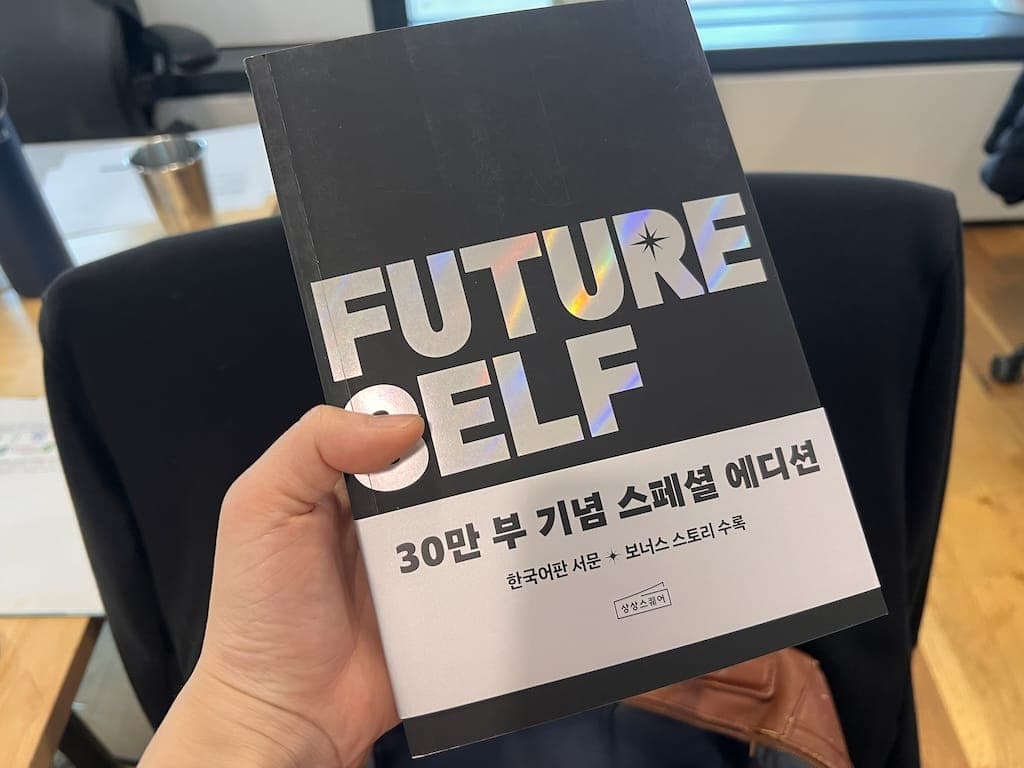
 Book
Book Book
Book