 Business
16 min read
#8 Are the Print Shops in Chungmuro Making Money?
I wanted to understand why Chungmuro has so many print shops.
It took me more than two weeks to post this fourth Money Machine piece — the classical concert one must have taken a lot out of me 😅. I had made a personal rule of writing at least one post every two weeks, so having fallen behind left me with a nagging guilt, like a summer diary left untouched until the last day of vacation.
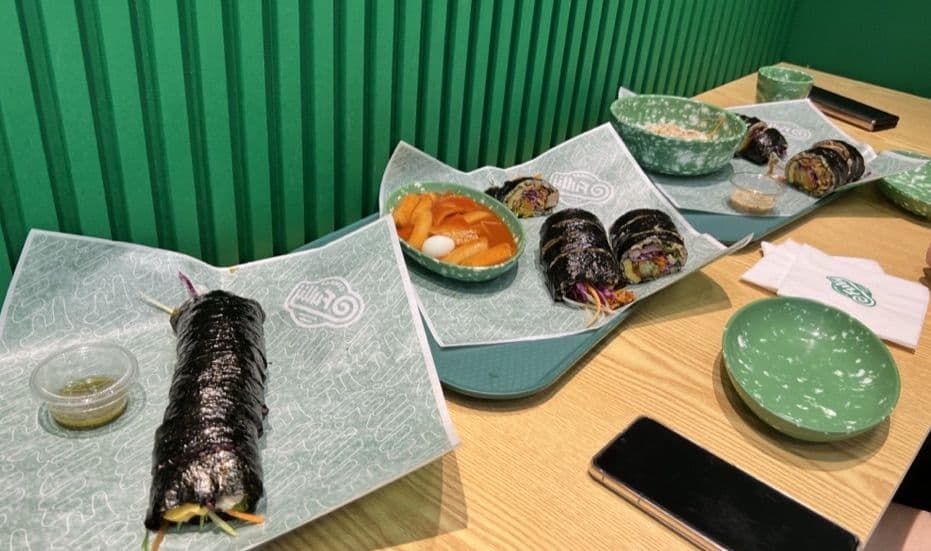
Lately I've been hearing a lot about kimbap shops, for some reason. A friend said kimbap is the one food they'd choose if they could only eat one thing for a week. And the triggering moment was probably visiting a new place near my office — a subway-style kimbap shop where you pick your own fresh ingredients. On top of that, a personal experience also shaped my choice of topic.
A few years ago, when I traveled to New Zealand, I visited what locals were calling a 'sushi restaurant,' expecting Japanese sushi — and felt a bit betrayed (?) to find various California rolls. As a Korean, I could see it was really a Western-style variant of a kimbap shop. Another interesting detail: those 'sushi restaurants' were almost exclusively run by Korean immigrant families. It's a personal observation, so I can't generalize, but I thought: Koreans, being familiar with kimbap, could re-brand it as 'sushi' (a form of upscaling), swap the fillings for locally popular ingredients like avocado and salmon, and that could make for a solid business in a foreign country.
These observations merged together, and I became curious: if a subway-style kimbap shop could make good money (in Korea), could I eventually open one like this if I ever emigrated?
The shop appears to still be in its early stages, so I've chosen not to name the brand directly — tagging it could feel like targeting, for better or worse. I'll describe it without revealing the name.
Beyond the basics, I ran the numbers as if I were opening this shop as a first directly-owned location, estimating cost of goods sold, SG&A, and capital expenditures as shown in the tables below.
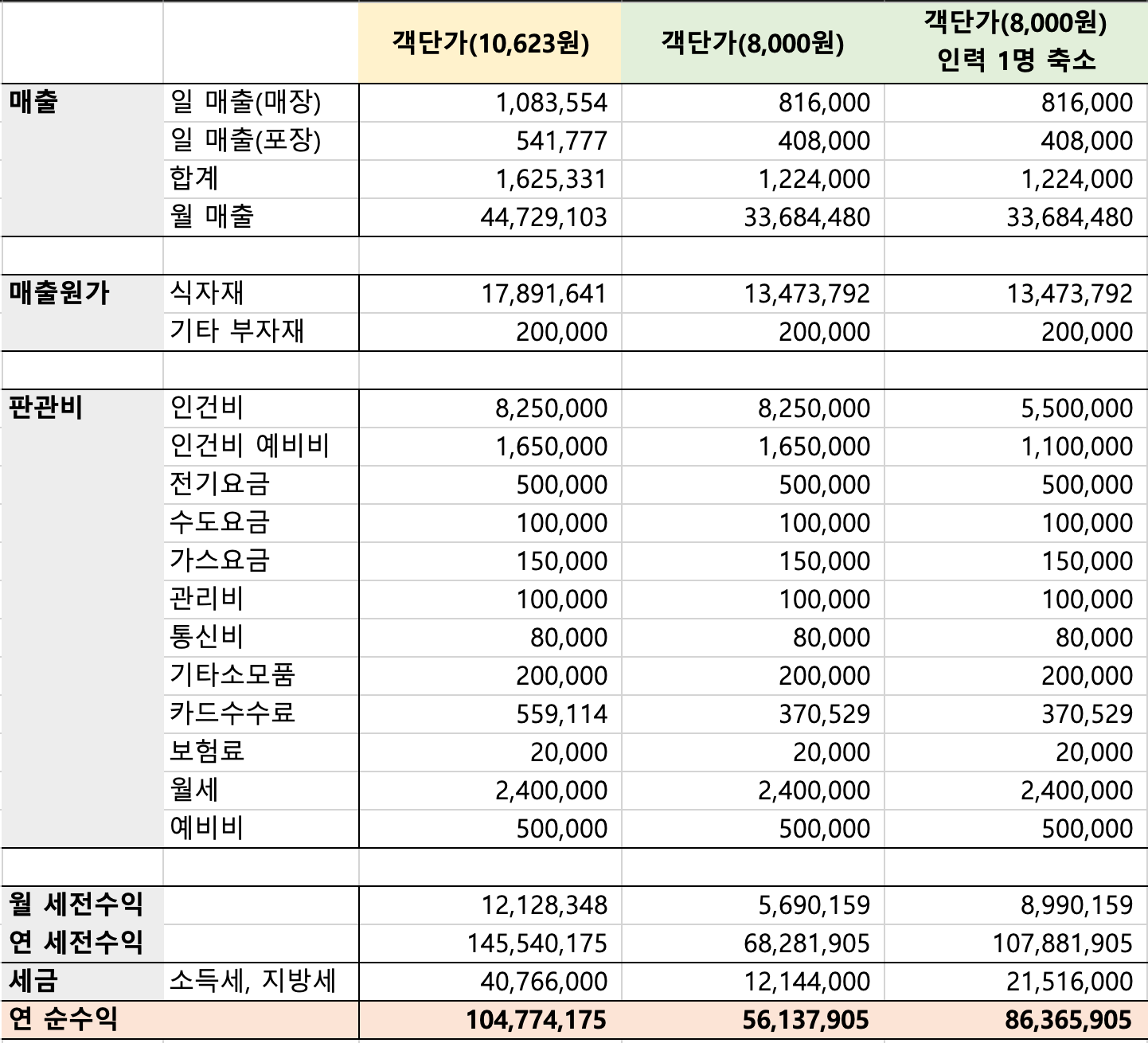
Estimated P&L for a 'subway-style kimbap shop' across three scenarios
Scenario 1 assumes an average ticket of 10,623 KRW.
Scenario 2 assumes an average ticket of 8,000 KRW.
No delivery service, so revenue is split between (1) dine-in and (2) takeout.
Food cost ratio assumed at 40%.
Labor: 3 staff assumed.
Hourly wage of 9,800 KRW applied, based on Subway's posted rate on part-time job boards.
Weekday: 5 days × 8 hours, including weekly holiday pay + 4 insurance → monthly salary 2,250,000 KRW
Weekend: 2 days × total 12 hours, no 4 insurance → monthly salary 500,000 KRW
Credit card fee rate varies by annual revenue: 1.1%–1.25%
Marketing, design, and occasional outsourcing costs included in contingency reserve.
Assuming one location run as a sole proprietorship → personal income tax applied.
Scenario 3 assumes replacing the 'rolling and slicing' role with a commercial kimbap-rolling machine and reducing headcount by one.
Finally, the upfront capital expenditure for setting up the shop:
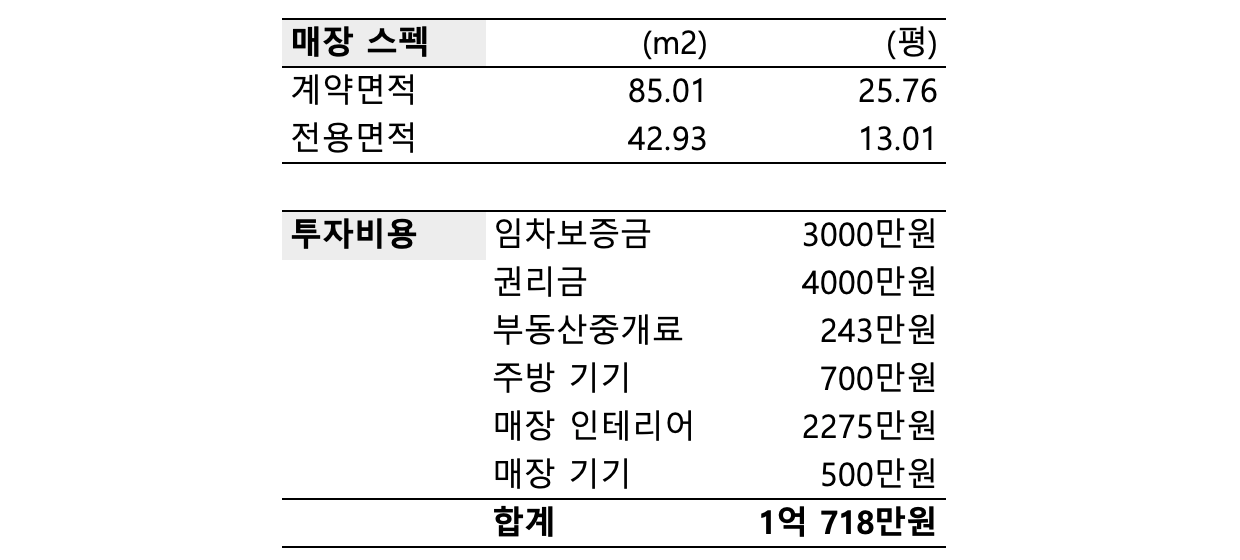
Initial setup capital expenditure
Looking at the subway-style kimbap revenue structure naturally made me curious about how it compares to opening a franchise kimbap location. Researching this, I found that franchise headquarters are legally required by the Franchise Business Act to disclose key business information to the Korea Fair Trade Commission. Using the information on the KFTC's disclosure portal, I compiled a comparison of several kimbap franchise structures in the table below.
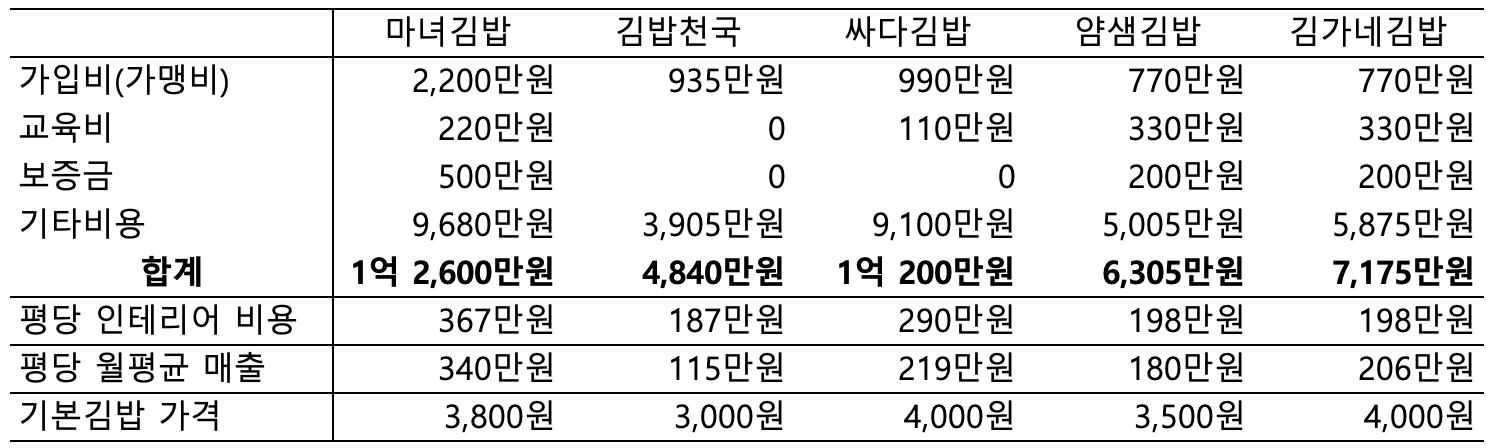
Kimbap franchise structure comparison table
Comparing the standalone shop structure with the franchise model in simple terms: if you have a differentiating idea for your shop and are willing to invest more of your own time, intelligence, and energy in the early stages — with a startup-founder mindset — starting an independent kimbap shop seems like the path to greater profit. Otherwise, entering an already-built franchise system is the safer choice.
Preparing all of this triggered quite a few thoughts:
Honestly, I started this post with a fun happy daydream: could doing a subway-style kimbap shop really well overseas lead to a global food brand like McDonald's or Subway? But I suppose "the more you know, the more it hurts" applies here 🤪. Having broken down the structure this carefully, the thought of opening one kimbap location and running it day after day feels suffocating. The survival instincts of the shop owners who grind every single day in the food industry are something to admire — and this thought experiment gave me an indirect but vivid experience of why 'business' and 'shop' are different things.
Being more interested in the startup world, I also found myself comparing this to starting a startup. The depth of deliberation and seriousness required to decide to start a kimbap shop is no less than what's required to start a startup. If anything, the day-to-day pressure of running a kimbap shop might be even more acute. And from a P&L perspective, since startups typically generate zero revenue early on, running a shop clearly wins. But then why do we usually think of startups as more valuable? Starting a startup is an attempt to leap directly to the 'business' stage — one that runs on systems — and it's the 'expectation' of being able to build that business structure that ultimately creates the value. Thinking it through this far, it seems that there is nothing inherently impressive about merely having started a startup — the only thing truly worthy of applause is having successfully made the jump from startup to business.
I'm surprised at how long this post turned out — clearly I thought through this topic quite seriously. My thoughts got away from me toward the end, so the conclusion doesn't land cleanly, but this was a post with unexpected lessons, and I expect it will stay with me for a long time.
BusinessI wanted to understand why Chungmuro has so many print shops.
 Business
Disclaimer: Based on a presentation delivered at the Seoul National University blockchain club Decipher's Weekly Session on the topic 'The Future of Banking.' This article explores the new forms of banking that can emerge when 'banking as a business model' meets 'blockchain as a new technology,' and examines the changes underway. Nothing in this report constitutes investment advice.
 Business
September turned out to be even more of a whirlwind than I expected, but as it drew to a close I sat back down to write. I knew if I let the month end without posting at least one Money Machine piece, I'd regret it when I looked back at my monthly post counts later.