Since I was young, I've had a desire to become someone who can see the "money-making structure" of things — and even better, someone who can build one. After years of just talking about it and getting frustrated with myself, I decided to assign myself some homework: to take products I encounter as a user, companies I look into for work or interest, and services that have become trendy recently, and write down my thinking focused on "how do they make money?" I started this blog hoping to find myself consistently writing, driven by the social pressure I'd created for myself.
The first service to examine — the Money Machine — is Sports Monster. On the kind suggestion of a friend to do something special instead of a typical weekend, I paid a visit to Sports Monster at Starfield Goyang. Let me look at the Money Machine from a user's perspective after spending 2 hours at Sports Monster (a.k.a. Sports Mob), which positions itself as "a playground for adults."
Overview
- Operating company: Wepeak
- Locations: 4 (Goyang, Hanam, Daejeon, Anseong)
- Types of attractions (Goyang location): Basketball game, racket game, baseball batting, baseball pitching, trampoline, slide, table tennis, volleyball game, adventure course, rally ball, vertical drop slide, step-up, handball game, clay shooting, running, 360 swing, climbing, jumping tower, archery, striker, darts, shoot & shot
- Pricing: Basic 2-hour usage; off-peak (₩26,000), peak (₩30,000) + ₩2,000 per additional 10 minutes
- Operating hours: 10am–9pm
💃 Impressions as a User
For an ordinary activity, ₩30,000 for 2 hours would feel steep — but as something special, it was a price I was happy to pay once. Considering the basic online discount (5%), a ₩5,000 first-visit promotion, and the off-peak/peak pricing, I'd estimate first-time customers pay an average of about ₩25,000 for 2 hours.
Out of the 22 total attractions, during my basic 2-hour session I prioritized attractions that felt exclusive to this venue: Adventure Course, 360 Swing, Vertical Drop Slide, Climbing, Jumping Tower, Trampoline, Volleyball Game, and Archery — 8 in total. After 2 hours of moving around I was more tired than expected, and even on a Saturday afternoon — prime weekend time — the wait for popular attractions was only about 10–15 minutes (subjectively, compared to Everland or typical theme parks), which made the 2-hour slot feel more than sufficient.
Before visiting, I assumed the core customer base would be millennials and Gen Z adults like me with a taste for childhood nostalgia. But there were more teenage customers than I expected. The types I directly observed were (1) couples, (2) groups of 3–5 teenagers, and (3) groups of 3–5 military personnel on leave — and roughly speaking, I'd estimate teenage groups made up about 50% of users. Weekends are mostly individual customers like me, but I'd guess corporate group clients dominate on weekdays.
💸 Estimated Money Machine Structure
Revenue
- Assuming peak usage is between 11am and 7pm on weekends (considering pre/post lunch and dinner times), I assumed 4 two-hour time slots per day.
- During my time slot (Saturday 2–4pm), I estimated about 50 users, so I assumed 50 customers per time slot.
- Weekend annual revenue: ₩25,000 (avg. ticket price) × 4 slots × 50 customers × 2 days (Sat/Sun) × 52 weeks = ₩520M/year
- I haven't experienced weekday corporate clients firsthand, but I made estimates based on a few reviews online.
- Assuming one team of about 50 people books the space like a venue rental per 2-hour session, with one morning and two afternoon slots — 3 teams per day.
- Group clients of 20+ get a discount, so I assumed a typical B2B discount of 20%, arriving at ₩1M per team per session.
- Weekday annual revenue: ₩1M × 3 teams × 5 days × 52 weeks = ₩780M/year
- There's an in-house snack bar, so snack and merchandise revenue can be added on top.
- Snack bar annual revenue: ₩10,000 (avg. spend per person) × 1,150 customers (combined weekend + weekday) × 52 weeks = ₩598M/year
- Roughly, just the Goyang location might generate about ₩1.9B/year. With 4 locations operating, total annual revenue is estimated at around ₩8B/year.
Costs
The main operating costs are (1) rent, (2) labor, and (3) equipment lease. Costs were harder to infer from experience alone, so I searched — and surprisingly found that Wepeak's audit reports have been publicly disclosed since 2019 🥹
- Rent: Before finding the disclosed documents, I tried to look up Starfield rental rates but couldn't. Still, like the saying "seek and you shall find," the audit report showed "Starfield Goyang Co., Ltd." as a related party, letting me see the related-party purchase amounts. In 2022, the amount paid to Starfield Goyang was ₩2.25B. Assuming this is entirely rent, and the Goyang location is ~1,500 pyeong, that's about ₩1.5M per pyeong — which I used to estimate rent for other locations.
- Search results: Hanam and Anseong are ~1,600 pyeong each, Goyang ~1,500 pyeong, Daejeon
665 pyeong — a total of 5,365 pyeong. At ₩1.5M per pyeong, estimated annual rent: **₩8B/year**.
- Labor: 47 employees as of 2023, average salary ₩35M plus 130% overhead — estimated ₩2.14B/year.
- Equipment lease: 10-year contract with one vendor, minimum ₩300M/year rising to ₩420M/year with revenue. I used the average: ₩360M/year.
- Adding these three major costs yields estimated annual costs of approximately ₩10.5B/year.
Result
Based on this chain of assumptions, Sports Monster's 4 locations appear to generate ~₩8B in annual revenue against ~₩10.5B in annual costs — an estimated annual deficit of ~₩2.5B. If making business decisions based on this scenario, I'd prioritize improvements in this order:
- (Revenue) Strengthen enterprise sales: Even by my estimates, weekday corporate clients represent the largest revenue segment. Starfield's broad marketing drives weekend walk-in traffic anyway, so Sports Monster can achieve the most effective revenue growth by focusing on enterprise sales. In the post-COVID era, companies large and small are thinking deeply about teamwork — activities that get people moving together, cooperating, and bonding through sport are exactly what many companies are looking for.
- (Revenue) Expand snack bar and merchandise: Once visitor numbers are up, the goal is to increase LTV. From my visit, the snack bar was too deep inside the venue to be visible, and I just went outside to eat after my session. Given the "healthy adult playground" and "sports-tainment" positioning, I wonder if I would have used the snack bar if they sold protein shakes or vitamin drinks — products hard to find at ordinary restaurants. Also, with quite a few staff required for safety, having idle staff run spot events in open spaces could generate additional revenue or marketing.
- (Revenue) Expand to regional Shinsegae-affiliate locations: Given Wepeak's relationship with Shinsegae, expanding to regional locations where entertainment options are scarce — without dramatically increasing rent — could be an avenue for improved profitability. But this is a more long-term, macro approach.
✔️ Wrap-Up — Checking Against the Audit Report
- Sports Monster is operated by Wepeak Co., Ltd., founded in October 2006 (initial capital: ~₩928M), initially focused on sports education and entertainment. In 2016, the company pivoted to Sports Monster as its core business.
- Thinking about just one location, I thought the structure was something I could estimate myself — and excitedly wrote up my scenario — until I found the audit report. There was a welcome feeling of getting closer to the truth, alongside nervousness at having my estimates graded. Key points from the disclosed documents:
- Shinsegae Property, which operates Starfield, is Wepeak's second-largest shareholder at 22.9%. Being a Shinsegae affiliate partner from the outset suggests that having this powerful ally was what enabled the dramatic business pivot.
- The numbers in the audit report differed significantly from my estimates for both revenue and costs 😱 The park business was hit hard during COVID, but looking at pre-COVID performance, I'd speculate that since COVID ended, the business could clearly be running in the black.
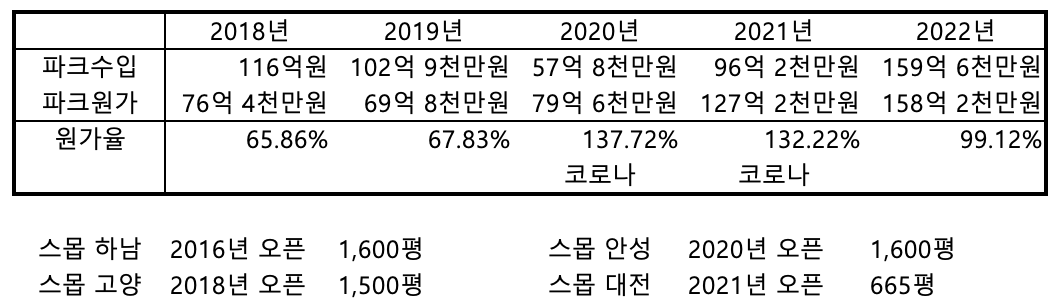
- Comparing the audit report against my own estimates, I was struck by the structural aspects I'm still missing — and felt clearly that I need more practice like this. There are far more data points that can't be captured by external research or thought experiments alone; filling those gaps requires active information gathering through experience and conversations with industry experts.
- Before writing this post, I used to occasionally estimate projected revenue and costs of small businesses in my head. Writing it out like this pushed me to dig into much more detail — and this was the most educational exercise of all, for my own benefit. I sincerely hope that writing more Money Machine posts will sharpen my ability to understand business structures, and I'll keep writing consistently.
Appendix — Other Thoughts
Looking at myself trekking all the way out to Goyang just to visit Sports Monster, I started to wonder whether Starfield had a specific reason for bringing Sports Monster in. Walking around, I noticed the spa facilities, movie theater, book café, kids' café, and screen golf range — and felt Starfield's effort to become a multi-purpose cultural complex. Traditional offline retail generated most of its revenue from "shopping" as both an economic act and a cultural/leisure activity, but consumers are already satisfied by department stores, supermarkets, and convenience stores close to home — with online shopping now aggressively claiming that market. That's why I think large-scale offline businesses like Starfield are transforming from retailers into landlords, converting physical space directly into revenue through leasing. And I found an article saying Starfield Goyang turned profitable within its first year of opening — confirming that non-shopping businesses like Sports Monster are filling the demand of that landlord model.
Closing
The reason I decided to write this post is to practice building the ability to understand how a specific business makes its money. I hope to keep this mindset going, and I'd be truly grateful if readers share ideas, suggestions, or corrections they think of while reading — kindly and openly. With each step forward, I aim to improve into writing that's worth your time.
 Business
 Business
 Business