 Book
Book7 min read
Thoughts on <DO HUMANKIND'S BEST DAYS LIE AHEAD>
amid these days so full of AI-driven FOMO, to consider what kind of future for humankind we ourselves hope for.
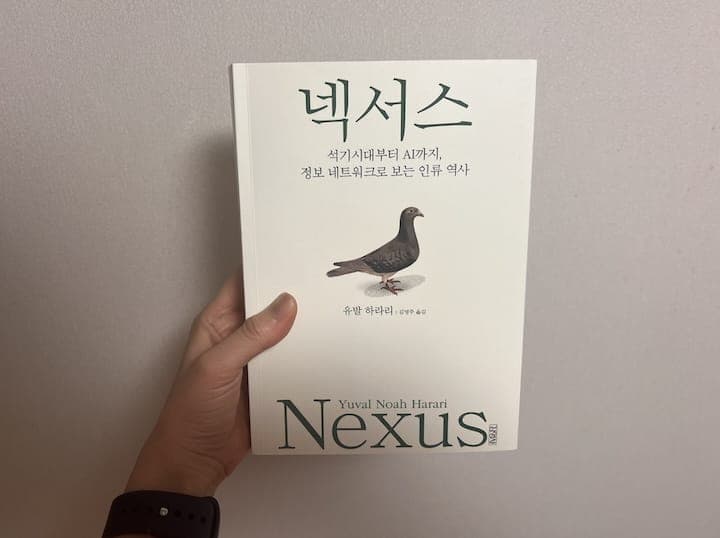
Yuval Harari has been a favorite author of mine since <Sapiens>. I find his macro-level interpretations of humanity's past, present, and future both fascinating and fresh. In <Nexus>, Harari continues that thread — discussing what AI means in the context of humanity's long history of expanding information networks, and what direction we should be heading. As someone who increasingly feels AI working its way deeper into daily life, this is a topic I find genuinely compelling. I'd been wanting to read it since it came out but kept putting it off until now. If you've been a Harari fan, this book has the same appeal as his earlier work — I'd recommend it.
A well-written book uses its table of contents as a good guide to the questions you should bring to your reading. After finishing, I summarized the table of contents briefly below — doing so helped the material crystallize more structurally.
Looking at the table of contents, the most important keyword in this book is clearly "information network." Like the book's title Nexus — meaning connection — the author argues that the fundamental characteristic of information is always to "connect" something. As he's argued in his earlier books, the secret to sapiens' success was their exceptional talent for using information to connect increasingly large numbers of individuals — and that's where this book begins. And the thing created by the exchange and connection of information is intersubjective reality: the laws, gods, myths, nations, corporations, and currencies of our society all exist because people who know the information trust it together — that's what makes them intersubjective realities. What's easy to misunderstand here is that more information doesn't bring us closer to truth. For an information network to succeed, it must carefully balance "truth-finding" and "maintaining order." Networks that prioritize truth can become wiser, but those that prioritize order can gain powerful control. That's why human civilization has oscillated between these poles throughout its rise and fall.
One concept I came to understand freshly through this book is bureaucracy. The word originated in 18th-century France, because bureaucrats of the time worked at desks with drawers (bureau), giving rise to "rule by the desk drawer." As this etymology suggests, bureaucracy is the concept of governing the world by dividing it into compartments — like filing documents into drawers. Bureaucracy is good for managing the world in an orderly fashion, but it has the side effect of making the world's principles and mechanisms increasingly fragmented and complex, making it harder for people to understand how the system works. Reflecting this against my own experience, I had long thought the world was becoming more convenient but not wiser. Comparing this to what the author says about human society balancing truth against order helped me understand that feeling a little better.
Another section I found fascinating was about the "sacred books" in religion. Once the concept of documents emerged, humanity no longer had to rely on oral tradition to preserve information across generations. Power shifted accordingly — away from the shamans, priests, prophets, oracles, and messengers who had previously transmitted divine stories, toward specialists who handled documents. The "sacred books" of various religions were, in fact, not originally delivered from heaven; they were records produced by the wisest and most trusted people of the time, recording what they agreed on. This too depends on people believing that these individuals had transmitted the divine word — and as those beliefs diverged, different religious sects (especially within Judaism and Christianity) emerged. Interestingly, what we today consider cutting-edge technology — distributed networks, blockchain — was anticipated by Jews roughly 2,000 years ago. They produced countless copies of the sacred law and ensured that every Jewish community and synagogue held at least one copy. Two purposes lay behind this: (1) democratize the religion by distributing copies widely; and (2) prevent arbitrary alteration of the text, strictly limiting the power of any would-be autocrat. I had always had reservations about religion — about how it silences fundamental questions with appeals to "the word of God," and how confessing to God seems to make people more susceptible to sin rather than less. The author's explanation made me feel that the doubts I had long held were not unfounded — and in a strange way, I found some comfort in that.
Beyond these points, the author explains democracy, totalitarianism, and political systems in his characteristically engaging way. Reading these sections, I was struck by how masterfully he connects insights and weaves them into stories readers can grasp. The part that resonated most was his observation that improvements in information networks have consistently come at moments of "discovering ignorance." "The Church told people to trust it, holding up an infallible sacred book containing absolute truth; but scientific institutions gained authority by actively encouraging the discovery and correction of their own errors — building their authority on a powerful self-correction mechanism." We often say that the printing press was the catalyst for the Scientific Revolution — but in fact, after the printing press was developed, history saw both witch hunts and the Scientific Revolution. The true catalyst for the Scientific Revolution, the author argues, wasn't simply printing technology — it was that the information networks in question were built on a powerful self-correction mechanism.
The latter half of the book interprets the new "inorganic information networks" — computers, algorithms, and artificial intelligence. The reason "inorganic" matters more than it might seem is that, until now, the members of information networks were exclusively human — and now computers are joining the network as members in their own right. It may still feel premature to some to view AI as equivalent to humans. The author addresses a common misunderstanding: we tend to think computers are consciousness-free entities that believe nothing and therefore lack subjectivity and cannot hold "intersubjective beliefs." But when many computers communicate with each other, they can create something resembling a mutual-computer reality analogous to human intersubjective reality. Cryptocurrencies like Bitcoin sit somewhere between intersubjective reality and mutual-computer reality. If any of this is true, then while we once only needed to understand the intersubjective realities — religions, nations, currencies — a society had created in order to understand it, we will in the future also need to understand mutual-computer realities to understand AI. Reading this, I immediately thought of a video that went viral on social media not long ago — AIs communicating with each other in sounds only they could understand, which I found genuinely unsettling. And the author's argument that humans are at a disadvantage in two ways when debating a computer pretending to be human really hit home: (1) bots are not entities that can be persuaded, so the time a human spends trying to persuade a bot is pointless; and (2) the more you talk with a bot, the more facts about yourself are exposed, and the easier it becomes for the bot to refine its arguments and influence your thinking.
After characterizing AI, the author explains how AI could be misused in both democratic and totalitarian contexts, and offers some safeguards we can at least prepare.
(Bad scenarios, excluding human extinction)
A few safeguards
This book doesn't only talk about AI — it starts from how human society has developed, so I was also able to broaden my understanding of democracy and totalitarianism in ways I hadn't expected. Lately, I've often wondered whether the global trend toward political polarization and the rise of populism is simply a result of stagnant growth — a world where people fight over a fixed pie. This book offers one answer: the world, including AI, is becoming increasingly incomprehensible, and when people can no longer understand the world, they readily fall into conspiracy theories and more easily trust the "human" they can understand. Reading this, I resolved to be wary of simply believing the easy, comprehensible opposite when faced with something I don't understand.
Personally, I've been using AI tools lately and have often thought that hallucination — "pretending to know" — is a serious problem. The author makes a forceful argument that we must check this. "Ever since currency was invented, it has always been technically possible to counterfeit money. But the financial system has protected itself for thousands of years by making counterfeiting illegal. The same strict principles applied to counterfeiting currency should be applied equally to AI that counterfeits human beings." This argument was genuinely persuasive.
Finishing the book, I find myself thinking: I've spent so much effort thinking about how to use AI well — but maybe services that check AI are also needed. More than anything, I think this book will be enormously useful to my future self, as a framework for interpreting AI-related phenomena through the lens of "information networks." For those curious about the author's even denser and deeper arguments that I couldn't fit into this review — I highly recommend reading the book directly.
Bookamid these days so full of AI-driven FOMO, to consider what kind of future for humankind we ourselves hope for.
 Book
Book Book
BookAs I've been getting more into tennis lately, the book <The Inner Game of Tennis> that I read about two and a half years ago came back to mind. When I first read it, I didn't know much about tennis, so I felt like I only understood about 30% of its message. Even so, the book's message about "relaxed concentration" was helpful for life in general — and with renewed passion for tennis, I was curious how differently it would resonate the second time.