 Book
Book7 min read
Thoughts on <DO HUMANKIND'S BEST DAYS LIE AHEAD>
amid these days so full of AI-driven FOMO, to consider what kind of future for humankind we ourselves hope for.

I first heard of this book when a respected friend I hadn't seen in a while gave a copy to everyone at the table. The author, Professor Lee Jung-dong, had also written the bestseller The Time of Accumulation, which this same friend had once insisted I read — saying it would be embarrassing for anyone with an engineering background to have missed it. That made receiving this new book feel like a warm reunion.
Personally, among the many types of leaders, I've often been told by people around me that I resemble less the style that presents a bold vision and launches ambitious initiatives, and more the style that takes concrete sequential steps toward a specific goal and moves an organization accordingly. I understand this simply as being closer to an Operational leader than a Visionary. But separate from what I'm good at, I honestly know in myself that I harbor a genuine desire to become the kind of Visionary leader who can articulate magnificent visions. So in the midst of this internal tension, I thought Professor Lee's questions to the world might hold hints for how to develop Visionary qualities without being limited to an Operational leader — because this book carries the message that for Korea to become a technology-leading nation, it must shift from being a problem-solver to being a problem-setter. Whether at the national, organizational, or individual level, it seems that what questions you carry makes an enormous difference. This book explains what the 'first question' should look like and why it matters.
Below I've excerpted the passages I want to remember, and I've added my own thoughts — marked with arrows — beneath the lines I felt like commenting on. You could read this as a summary of the book from my perspective; feel free to skim for the parts most relevant and resonant for you.
The fact that most developing countries have remained on the periphery for so long is evidence of how difficult it is to challenge gravity. When Korea, then essentially an agricultural nation, sought to begin heavy-chemical industrialization in the 1970s, experts in advanced countries expressed negative opinions not out of any malicious intent to obstruct Korea's development, but from the logical judgment that entering an unfamiliar domain would be difficult. When Samsung declared in 1983 that it would enter the semiconductor industry, Japan's Mitsubishi Research Institute predicted failure citing five reasons: Samsung lacked technical capability, the company was too small, Korea's domestic semiconductor market was too small, the upstream and downstream industries supporting the semiconductor sector were underdeveloped, and social overhead capital was insufficient. It was a pessimistic but thoroughly commonsensical and logical forecast.
→ Keeping this example in mind, I think it can serve as a reminder that sometimes the most logical and rational argument can turn out to be wrong.
Foreign direct investment (FDI) can build an industry overnight because global companies bring both capital and technology. However, it often ends up serving merely as a low-value-added, simple processing factory without any technology transfer. Returning to Korea's story, rather than taking the FDI elevator, Korea chose the hard way — borrowing capital directly, building factories, securing equipment, and producing — an exhausting climb up the stairs. It was a method with a high likelihood of failure and virtually no precedent for success. Having chosen this path, there was no choice but to learn the technology and solve the problems oneself.
→ Looking at various national statistics from an investment perspective, I inevitably encounter FDI figures — and I had always assumed that the larger the FDI, the higher a country's growth potential. But being able to look at FDI from this different angle — as a lens on technology accumulation — was genuinely useful.
In the business world, the same principle of combination applies. Rather than trying to address a bold, original question through a single idea, the answer must be constructed through the combination of existing technologies and experience.
When people share the advanced knowledge materials of their era, the direction and level of their questions becomes similar as well. That's why many people simultaneously raise similar original questions that differ only slightly. For example, in 17th-century European intellectual circles, discoveries in astronomy and mathematics appeared in rapid succession as new materials for combination, existing as a kind of shared knowledge commons. In this environment, Robert Hooke, Gottfried Leibniz, and Newton were thinking along similar lines. Leibniz and Newton in particular raised the question of whether a new technique for dealing with rates of change might exist — and almost simultaneously discovered calculus.
→ The author is saying that the environment enabling the original question — sufficient access to advanced knowledge materials and existing technology and experience — is the decisive factor for good original questions to emerge. It makes me wonder whether I am in such an environment.
In biology, if mutations are too diverse, new species are hard to create — because too little is passed on. Technology evolution is the same. Whether researcher or entrepreneur, if you try this today, and that tomorrow when it doesn't work, poking at whatever you see or hear without direction — you cannot become exceptional. Without direction, there is no learning or accumulation from failure, and questions naturally don't get updated. If you have a direction — the original question — you gain a lesson for course correction even when today brought no results and only failure; without direction, the moment of failure makes you think about packing up and leaving rather than learning anything.
→ This doesn't only apply to the grand concept of direction — it's a question I've been asking myself a lot lately about my own career direction. In my twenties, trying various things worked well enough. But I think from my thirties onward, I need to seriously decide and commit to what domain other people would actually need me in and value me as an expert. I worry that I haven't found that domain yet.
Technology is bound by logic; humans are bound by meaning. The field of logic and the field of meaning influence each other and change together. That's why it's important for us, as humans, to continuously reflect on meaning and vision and actively project that onto the direction of technological evolution. In other words, rather than accepting the logic of technology uncritically, humans must be able to determine the direction of technological evolution through human will.
→ As AI has received enormous attention recently, many ask how humans and technology will coexist as it develops. My sense is that as cutting-edge technology advances, the human role will be to make final decisions, take responsibility, and assign meaning.
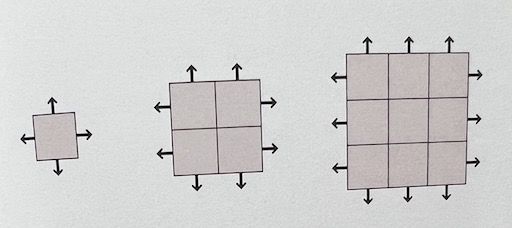
Once a company passes the startup phase and grows larger, it begins to spend more attention and time on the internal view than the external. In other words, the larger a company grows, the more likely it is to develop 'Galapagos syndrome.' Why? If each square represents one employee, when the organization has 100 employees, only 28 squares are touching the outside. The remaining 72 squares only touch internal squares — receiving outside stimulation only indirectly, making internal communication the central concern.
→ Comparing organizational size to expanding squares is a simple but intuitive and effective illustration of the growing pains organizations experience as they scale. To address this problem — from the perspective of this analogy — organizations need to periodically ask whether their growth is mere volume expansion, or whether it's a creatively shaped expansion that also grows surface area.
There's a term called the HIPPO (Highest Paid Person's Opinion) syndrome. Since HIPPO refers to the opinion of the highest-paid person in an organization, HIPPO syndrome refers to the problems that arise when a superior dictates answers and dominates decision-making. In organizations where the superior says 'I know best' and has subordinates take dictation on what they believe the answer is — and where subordinates uncritically comply, thinking 'whatever the leader says must be the answer' — challenging original questions are hard to emerge, and scale-up is obviously out of the question. This is because they don't tolerate the trial-and-error that inevitably accompanies bold challenges. When you think about it, if the superior has already supplied the answer by saying 'do it this way and that,' then the only explanation for when trial-and-error occurs is that subordinates lack competence or are being lazy. These HIPPO-like leaders always propose plans that appear set up to succeed, so they seem to deliver good results in the short term.
→ I've personally experienced that even when very talented people are gathered together, HIPPO can happen. I desperately want to avoid becoming that kind of organization, but I also know from experience that it's not easy — which is something I genuinely struggle with. Still, the solution I can offer to avoid HIPPO syndrome is: organizational members must have fundamentally strong capabilities, and on that foundation, the organization must give members a sufficient sense of being protected when sharing opinions and going through trial and error.
The secret of creative design is sometimes expressed as '99% manual, 1% creativity.' Innovative technology is certainly the answer to the original question, but if the trial-and-error experience in the process of finding the answer is not systematically accumulated and utilized, there can be no phylogenesis — only ontogenesis, where every time a person changes, the same mistakes are repeated. When the manual is high-quality and continuously updated, the level of the questions naturally rises as well. This is because there's no more wasting time by mistaking a question that's already been answered for a new one.
→ The concept of accumulation seems critically important not just in technology but in management as well. It makes me think again about the importance of strengthening the constructive function of manuals — reducing time spent on past trial and error and securing time to genuinely answer and think about the questions that really matter. On the flip side, for work that is said to be incapable of accumulating manuals, since there is no accumulation or progress, you have to think about whether the organization should be investing time in it at all, and whether there's a way to minimize it.
Another expression for China's 'Chinese Dream' is leading global standards. It is also part of a global strategy linked to the Belt and Road Initiative. In smart city technology, China has already partnered with over 100 cities worldwide, embedding 'China Standard' across sectors like transportation, administration, and media services.
Schumpeter also brought 'entrepreneurship' to the surface. Entrepreneurship refers to the will to relentlessly seek solutions while asking original questions, based on a vision of innovation: the motivation to unfold one's own worldview, the desire for commercial success, or the pure hope of creating something new. And this will is inherent in human nature. Schumpeter, with remarkable insight, discerned that the market economy has inside it the growth engines of 'entrepreneurship' and 'creative destruction.' In other words, entrepreneurship inherent in human nature creates innovation, and the economy grows through a process of creative destruction that drives out old technologies and companies.
Schumpeter's entrepreneurship and creative destruction have one important premise: sharing the pain of those on the side being destroyed. The entity best positioned to share that pain is, of course, the state.
The most reliable patient capital is obviously money the company has earned itself. However, as Anglo-American shareholder capitalism has gained dominance recently, profit distribution — through share buybacks and increased dividends — has intensified, squeezing long-term investment capacity. When shares are bought back and retired, executives and major shareholders benefit — but projects challenging new technology become candidates for review. The same is true of dividends. In 2020, all listed companies combined paid over 34 trillion KRW in dividends, and the dividend yield has already surpassed levels seen in the US, France, and China. Moreover, 40% of dividend amounts — 14 trillion KRW — went to foreign investors with high short-term investment tendencies and flowed out overseas. The original function of finance is to spread the risk of ambitious future investment, but somehow the situation has been inverted: finance's short-term profit-seeking logic is now strangling innovation investment in the real economy.
→ Personally, this section made me reflect on the need to broaden my perspective on investment.
The secret to a vibrant industrial ecosystem full of innovation is, when you look closely, quite simple. Metabolism is the key — where uncompetitive companies disappear and new companies challenging with innovative technology and business models get opportunities. If this mechanism of entry and exit — creation and destruction — doesn't function smoothly, the industrial ecosystem stops growing, just like the human body.
There is no internationally agreed-upon standard for what constitutes a zombie company. In Korea, the term 'marginal company' is used instead. Generally, companies where the interest coverage ratio is below 1 — meaning operating profit cannot cover interest expenses — for three or more consecutive years are classified as marginal companies. Policymakers in the financial sector and industry policy assess how urgently restructuring is needed by looking at the number and proportion of such marginal companies.
The state of marginal companies is at a worrying level. According to surveys by the Bank of Korea and related institutions, the numbers vary slightly by methodology, but as of 2020 it is generally around 15–20%. There is also analysis suggesting Korea has the fourth highest proportion among OECD countries. What's even more worrying is that the proportion of marginal companies didn't suddenly increase with the COVID crisis — it has been gradually rising over the past decade. It may be a precursor symptom of the Korean industrial ecosystem's metabolic rate continuously slowing and 'Japanifying.'
Starting now, the entire financial sector must develop sweeping, organized strategies to build specialized capabilities in industry and technology. The effort to improve government agencies responsible for supporting marginal companies in their ability to distinguish zombie companies from seed companies cannot be delayed.
Indian-born economist Amartya Sen received the first Nobel Prize in Economics awarded to an Asian person in 1998 for his insights on poverty and inequality. Sen's core argument is that humans become happy not when they consume more, but when they fully express their unique capabilities. The reason poverty, inequality, and discrimination are bad is that they restrict the very opportunity to exercise capability. Because people are never even given the chance to turn on the switch of their potential capabilities, no matter how much gold and foreign currency fills a country's vaults, that society cannot develop or become happy. The UN adopted his thinking and developed the Human Development Index, publishing national measurements every year.
→ I've said that I feel happiest when I feel a sense of achievement — I'm pleased to find that a Nobel laureate in economics has made a supporting argument.
The fact that exceptional scientists and innovative entrepreneurs emerge in large numbers from technology-leading nations is not because they chose where to be born. Everyone is born with a switch for scientific and entrepreneurial capability — but it is the environment of a technology-leading nation that flips those switches and opens the opportunity to invest 10,000 hours of effort. That's why Warren Buffett's self-assessment — that 80% of the wealth he's earned is attributable not to his own talent and effort but to the society he belongs to — is not humility but fact.
→ Similarly, there was once a story that became viral about a genius boy in Africa who, without any education and grateful not to have died of starvation, independently accumulated knowledge and invented a bicycle. But looking at this from a different angle: we could understand bicycle mechanics in just a few hours, yet simply being placed in different environments means this boy had no choice but to spend his genius on inventing a bicycle over an entire lifetime. That inequality is striking. The reason those who have succeeded reinvest in society tend to invest heavily in education can be interpreted as the will to resolve this kind of inequality.
This was a very easy read, yet it contained more resonant passages than I expected. Every time I read Professor Lee's books, I find myself worrying about Korea and wondering about my own role — which makes me newly realize that patriotism is alive in me after all.
Before reading this book, I wanted to find the answer to how to become a Visionary leader. The book states it simply: an organization that asks the original question and endures the hard time it takes to answer it. Thanks to this book, it will serve as a periodic reminder to check whether the organization and environment I belong to are oriented toward the original question as their direction. What questions are you carrying? I've gained a good question to ask the people around me.
Bookamid these days so full of AI-driven FOMO, to consider what kind of future for humankind we ourselves hope for.
 Book
Book Book
BookAs I've been getting more into tennis lately, the book <The Inner Game of Tennis> that I read about two and a half years ago came back to mind. When I first read it, I didn't know much about tennis, so I felt like I only understood about 30% of its message. Even so, the book's message about "relaxed concentration" was helpful for life in general — and with renewed passion for tennis, I was curious how differently it would resonate the second time.