 Book
Book7 min read
Thoughts on <DO HUMANKIND'S BEST DAYS LIE AHEAD>
amid these days so full of AI-driven FOMO, to consider what kind of future for humankind we ourselves hope for.
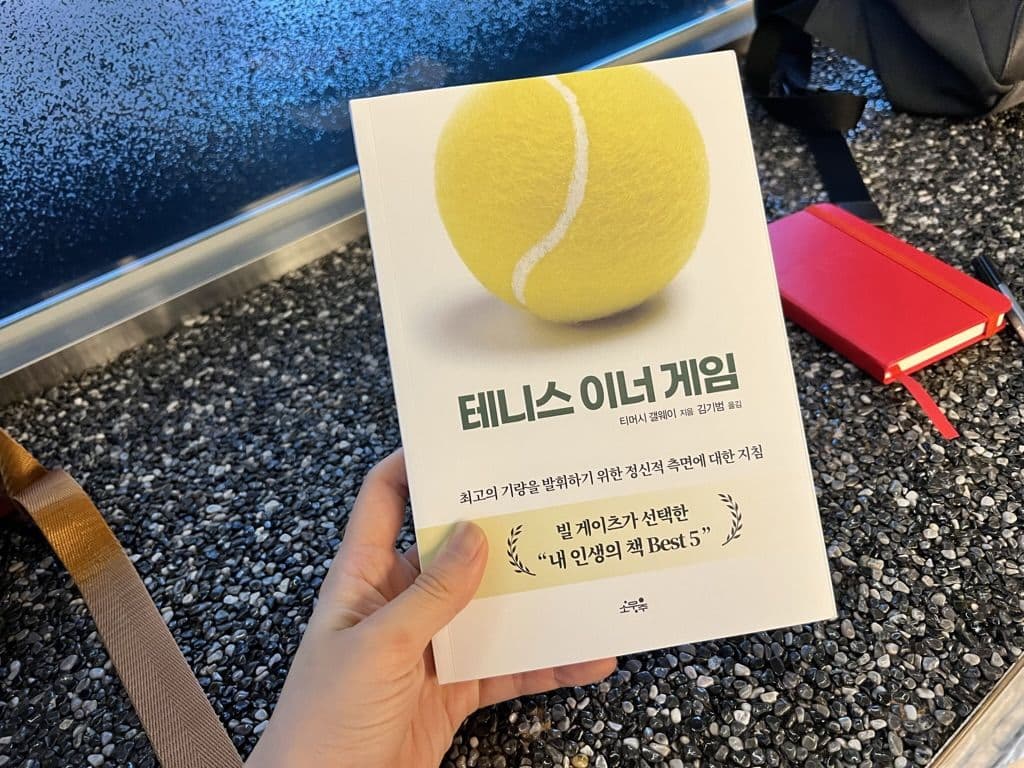
Bill Gates, known as one of the world's most voracious readers, says there are very few books he has read multiple times — and this is one of his top five books of all time. I was curious what it could be, and I also secretly hoped that reading something about mindset right after finishing a novel — with my mind loosened up — might make it land more effectively.
I only ever played tennis in one beginner's course during a single semester in college, but the 'inner game' this book describes — ultimately the work of taming the mind — is a teaching that applies to every sport and to every moment in life. While reading, I kept mapping the concepts onto my own situation. In particular, I've often heard the phrase "It takes a year of golf just to learn how to relax" — and I came to understand through this book that the tension it describes is the side effect of Self 1's interference, and that "relaxing" is really about fully trusting Self 2. That connection was satisfying to make.
For a book like this, I think the best way to write a review is to faithfully record the sentences I want to return to again and again, so that readers gain something just from reading this post alone. My own thoughts scattered in between are just for fun — I hope you'll take them lightly ☺️
For a player engaged in the inner game, the skill of concentration in a relaxed state is of paramount importance. They will then discover the true foundation of confidence, and learn that the secret to winning is not trying too hard.
A player who concentrates in a relaxed state knows where to send the ball but doesn't 'try hard' to send it there. They just do it naturally — more accurately than expected. They are performing a sequence of movements in a state of flow and hitting powerful, precise shots. The moment one becomes conscious of these 'magical shots' and tries to sustain them, they stop appearing. Try to control them and you lose them.
It's paradoxical that 'not trying too hard' is what enables you to perform better. But surely everyone has had this experience at least once — it's worth revisiting those moments.
What the inner game seeks is to evolve and develop the potential inherent in a human being.
Recently I asked myself: 'Why does it matter to live earnestly?' The thought would often arrive at the same conclusion: 'Having a healthy body and being able to encounter good opportunities was fortune — the way to be grateful for that fortune and give something back is to draw out my potential to the fullest during the time I'm alive.' So when this book also says the reason for pursuing the 'inner game' is the development of potential, it resonated anew.
What happens the moment a player hits the ball? If you look carefully at their expression, you can see the facial muscles tense, lips pressed tight with an air of intense concentration. But in truth, tensing the face doesn't help you hit a better backhand or aid your concentration at all. Who is making this effort? Self 1, of course. But why? Self 1 is the commander, not the executor. Self 1 does things itself because it doesn't fully trust Self 2. This is the crux of the problem. Self 1 doesn't trust Self 2 — even though Self 2 is the one who expresses all your potential and is far more skilled than Self 1 at coordinating your body's muscles.
This 'overeffort' can be overcome through the following three inner skills:
- Knowing how to picture the outcome closest to what you desire
- Learning to trust Self 2 — that is, allowing Self 2 to try its best and learn from success and failure
- Learning to observe without judgment — that is, seeing things as they are without labeling them good or bad
- Step 1: Observe without judging
- Step 2: Picture the desired outcome
- One approach is to watch a player with a powerful serve. There's no need to analyze too deeply. Accept what you see as it is and try to sense what it feels like to serve that way. Listen to the sound of the ball hitting the racket, and watch what happens. Then imagine yourself serving naturally, in your own regular form — but more powerfully.- Step 3: Trust Self 2
- Try varying the grip pressure and feel how you're holding the racket. Notice what it feels like to flex your wrist all the way back and then all the way forward. Don't assume you truly understand something just because someone told you about it. You have to feel the movement of your own wrist yourself.- Step 4: Observe the changes and results without judgment
If Self 1, through ignorance or arrogance, fails to acknowledge the abilities of Self 2, true confidence becomes hard to attain.
If Self 1 recognizes the innate intelligence and potential that Self 2 possesses, it can learn to adopt an attitude of respect toward Self 2. This attitude is called humility — a feeling that arises naturally toward something you genuinely respect.
When Self 1 intimidates Self 2, it's akin to treating yourself as a computer that simply obeys commands rather than as a human being. The information needed to perform desired movements is stored in muscle memory, and distrust of Self 2 blocks access to that muscle memory.
A child doesn't abandon the habit of crawling — it doesn't even think of crawling as a habit. It simply discovers that walking is a more convenient way to get around and shifts to the new habit, leaving the old one behind.
The habit of judging your own play as good or bad must be abandoned. Non-judgment is the most fundamental cornerstone of the inner game.
When we plant a rose seed in the ground, we may think it's small, but we don't criticize it for lacking roots and a stem. Because we see it as a seed, we water it and give it nutrients.
To see a stroke as it truly is, there's no need to assign it the meaning of 'good' or 'bad.' The same goes for the result. Even if the ball goes out, there's no need to call it a 'bad' event. Simply notice how far outside the line it went. Not judging doesn't mean you fail to see the essence of what happened. Removing judgment means not adding anything or taking anything away from what you observe. See things in their undistorted reality.
To stop a thought, you must put it somewhere else. It can't simply cease to exist. That's why concentration is needed. When you concentrate, the mind becomes calm. When the mind stays only in the present, it settles. You need to keep the mind here, in this moment.
Focus on watching the seams of the ball, and combine that with listening to the sound it makes.
The most effective way to maintain focus is to concentrate on breathing. To sustain concentration, you need something that exists continuously in the present or an activity that is always ongoing. What could be more present than breathing?
Interestingly, in this state of genuine immersion and focus — where Self 1 has stepped aside and only Self 2 remains — you always feel better, your awareness sharpens, and your performance typically improves greatly as well.
During Michael Jordan's years with the Chicago Bulls, coach Phil Jackson — who led four NBA championships — wrote about Self 2's kind of concentration in his book Sacred Hoops:
"Basketball is like a dance moving at the speed of light. You need firm resolve, and you can only succeed by being fully focused on every player on the court. The secret is to clear your mind. I don't mean to think of nothing — you need to let your body move instinctively according to your training. To do that, you have to shut out the intrusive noise that constantly tries to barge in."
Bill Russell, the legendary Boston Celtics player, put it this way: "When you reach a higher level, strange things happen. It feels like you're playing in slow motion. In that state, you almost sense intuitively how the next play will unfold, where the next ball will go. Anyone can concentrate. Anyone can be alert."
Of all the examples given about concentration, Phil Jackson's and Bill Russell's resonated most personally and are passages I want to hold onto.
Self 2 is always present in a young child. As the child grows and the things vying for their attention multiply, Self 2 becomes harder to perceive. But Self 2, as it has always been, will be with you always.
Why we leave here, and this moment, is unknowable. It is the only time and space in which we truly exist — in which we can truly enjoy and achieve anything.
Most of our worries stem from attachment to the past or anxiety about a future that hasn't arrived. And yet people who feel satisfied with the present moment are extraordinarily rare. The desire to be different from who we are now draws us into the world of unreality. As a result, the sense of gratitude for the present gradually fades. The moment our mind pursues unreality — a past or a future — it leaves the real world. To understand why we lose the state of concentration, I needed to know precisely what I was pursuing.
To concentrate is the ability to keep your mind from wandering away from you. It doesn't mean not thinking — it means actively directing your own thoughts.
A towering wave crashing with immense force is exactly what makes a surfer perform their best. Only when facing a big wave do they summon all their skill, courage, and concentration to overcome it. In that moment, they can feel the outer limit of their own ability. Their peak performance emerges. In other words, the greater the challenge faced, the greater the opportunity to discover and expand one's true potential. Potential is always latent, but unless it surfaces through these activities, even you yourself won't know it exists. Obstacles are an indispensable part of the process of self-discovery. Through the surfer's example, I came to understand the meaning of winning more clearly: winning is the process of overcoming obstacles to achieve a goal, and the bigger the goal, the greater the meaning of the victory.
I arrived at the surprising conclusion that true competition is, in fact, true cooperation. Every player tries their best to beat the other, but when you consider the true meaning of competition, what we're winning isn't the opponent. It's simply a matter of whether we can overcome the obstacles the opponent provides. In true competition, there are no losers. Both players gain something in the process of overcoming the obstacles each provides to the other.
Reading this section on the meaning of true competition and winning, I was reminded of something a teacher said to me in childhood that made a deep impression. "If the effort is equal, it's better to be the tail of a dragon than the head of a snake. No matter how well the snake does, it lives only on the ground — but the dragon gets to fly in the sky." What made these words such strong motivation for me at the time was the intuitive understanding that 'if I'm already prepared to work hard, I should challenge harder and more difficult goals and expose myself to environments that provide that difficulty.' It connects to the idea that life is ultimately a battle with oneself.
When pressure comes from every direction, it's hard to avoid stress. A spouse, a boss, children, bills, advertisements, and the society we belong to all make demands on us constantly. Because the demands come so naturally, they can feel like part of life itself. At other times the demands are so harsh that fear makes us feel we have no choice but to be dragged along.
The source of stress can often be summed up with the word attachment. Self 1 depends on the objects, situations, people, and ideas it has experienced, so when change occurs or threatens to occur, it feels threatened. Freedom from stress doesn't mean giving up. You need to be able to simply let go when necessary, and realize that's okay. This comes from becoming a more independent self — which doesn't mean being more lonely, but trusting the inner resources of one's own stability more deeply.
Regardless of where you were born, every Self 2, from the moment of birth, has an inclination to pursue its own nature. To enjoy, to learn, to understand, to appreciate, to pursue, to rest, to be healthy, to survive, to be free, to express oneself, and to make one's own contribution. When you act in alignment with this self, a kind of fulfillment follows.
I don't believe in self-improvement, and I don't actually want to improve the self. Some people are surprised to hear this. But I believe that no one's Self 2 — from birth to death — requires improvement. Self 2 is always right. More than anyone else, I need to remember this about myself. Our backhand can improve; my writing skill has room to grow. Our skills for interacting on this planet can get better. But recognizing that there is no flaw in human nature that needs to be fixed is the very foundation that can bring peace of mind.
Having had these negative thoughts about myself, I lived a life of striving to do better. But it was never enjoyable, and it never brought appropriate reward. I could meet or surpass the expectations placed on me to please or appease someone, but at the price of sacrificing my relationship with myself. Self 2, when left alone, performs beautifully in its given role. I was able to experience this very concretely in the process of pursuing the 'inner game' in tennis.
Concentrating on the present moment — the only moment in which you truly exist — is the core message of this book, and the foundational skill for doing everything well.
I often feel fatigued by the enormous volume of information, articles, and news I need to keep up with every day. And while I live busily, telling myself time is precious, the irony is that this very urgency about saving time often means I can't actually concentrate on the meeting I'm in, the person I'm talking to, or the activity I'm engaged in right now — and that emptiness hits me sometimes. Reading this book renews my resolve to practice being present and focused.
Bookamid these days so full of AI-driven FOMO, to consider what kind of future for humankind we ourselves hope for.
 Book
Book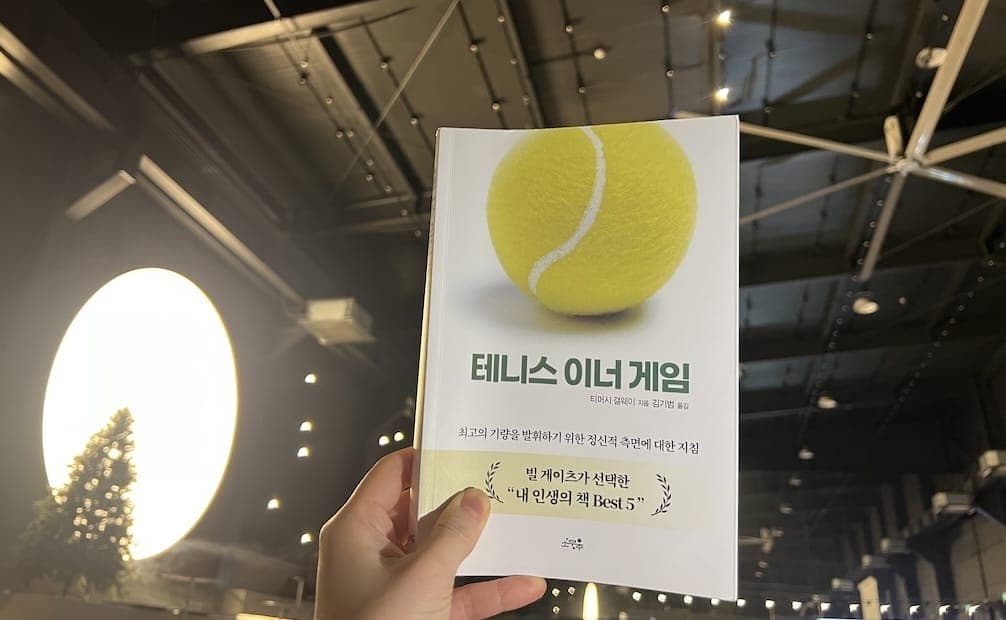 Book
BookAs I've been getting more into tennis lately, the book <The Inner Game of Tennis> that I read about two and a half years ago came back to mind. When I first read it, I didn't know much about tennis, so I felt like I only understood about 30% of its message. Even so, the book's message about "relaxed concentration" was helpful for life in general — and with renewed passion for tennis, I was curious how differently it would resonate the second time.