 Business
16 min read
#8 Are the Print Shops in Chungmuro Making Money?
I wanted to understand why Chungmuro has so many print shops.

Just as Warren Buffett is known for favoring 'tollgate' businesses — those you must pay to pass through — whenever a new industry is growing enormously, I find myself wondering what that industry's tollgate business might be. For a long time, when thinking about what business could be done in the AI industry, I thought that securing AI training data would fit Buffett's concept of a 'tollgate business.' Through this post, I want to examine whether the AI training data business is actually a tollgate business capable of generating sustainable profit, and understand how its revenue model works.
To quickly grasp how much attention and scale a market commands, how it has evolved, and the differentiation strategies each player has adopted to survive, looking at the key players is the place to start. I've summarized the top 7 AI training data companies in Korea by investment or revenue scale in the two tables below.
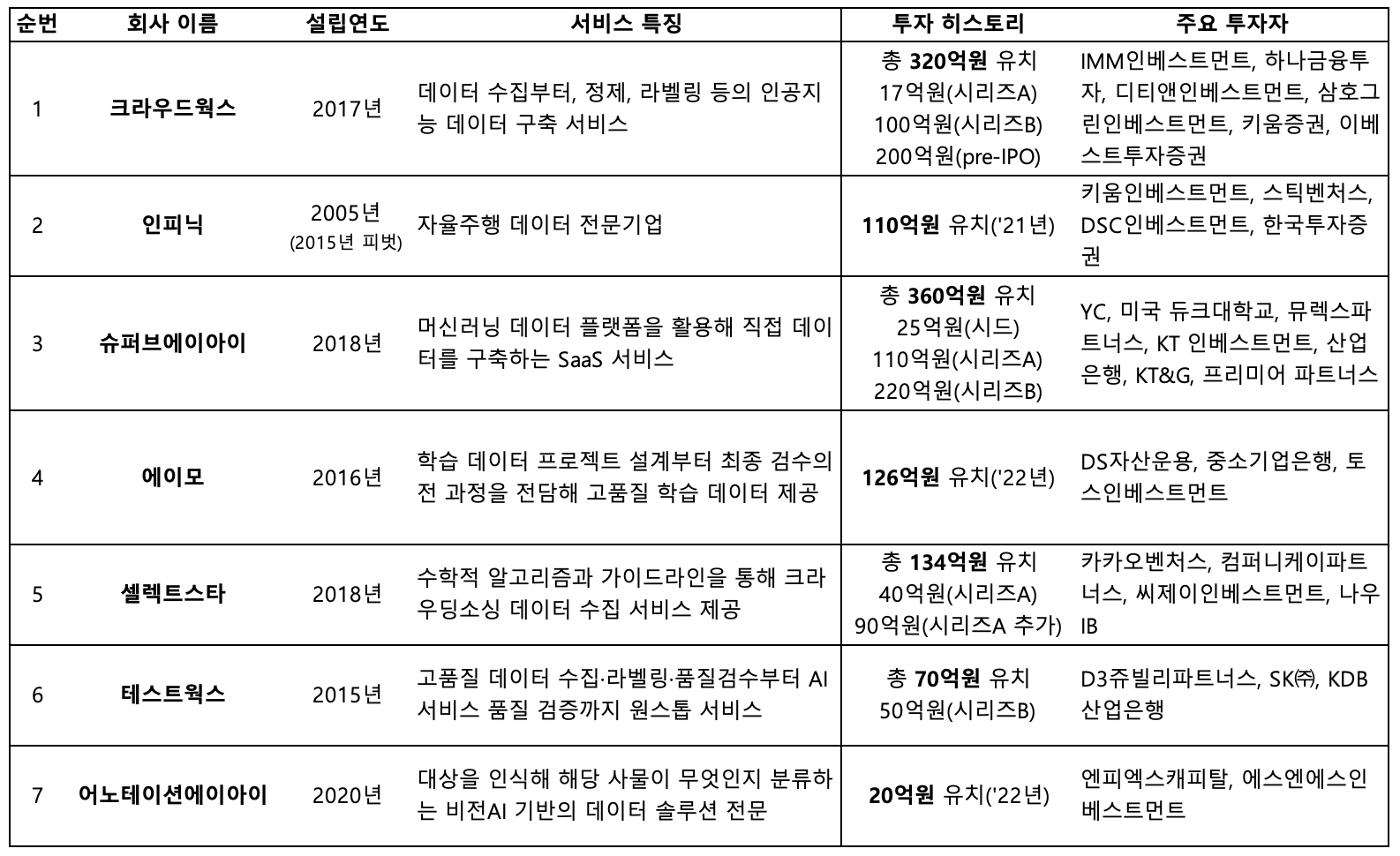
Summary of 7 companies: founding year, service description, investment
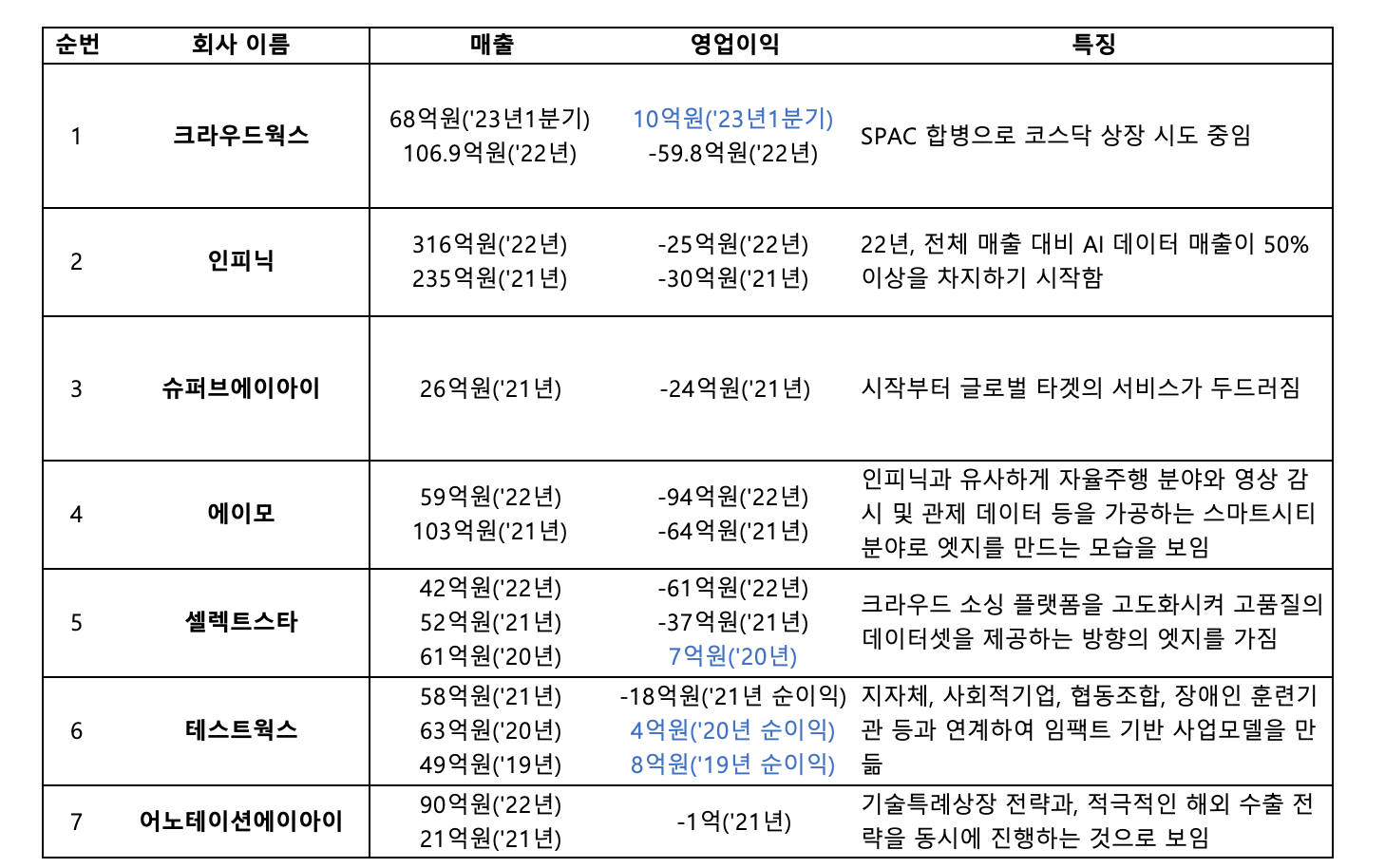
Summary of 7 companies: business results and characteristics
From comparing these seven companies, I identified three characteristics common to the players in this industry.
The AI training data construction business is a foundational service for the AI industry and a business type needed in the early stages of market formation — which makes investment from market-forming entities like government necessary. For now, government-led demand is the most visible, while private and corporate data demand is likely growing quietly below the surface. Current AI training data demand can be broken down as follows:
Running through all this, I found myself doing an interesting thought experiment: if I were the CEO of an AI training data company right now, what strategies would I need to pursue to survive and grow? I organized my thinking into three core directions:
As the saying goes, data is gold — and good data holds value as intellectual property, which makes the question of who owns the constructed data a critical one. It would be hard to capture ownership of all data from the start. But steadily reinvesting the cash generated from simple service contracts back into the company — proactively building data in domains where demand is expected to grow — and then increasing the share of revenue from selling that data to multiple buyers would become a meaningful competitive advantage.
Looking at current government project announcements and major revenue sources for these companies, autonomous driving and healthcare appear consistently. Some industries are growing their markets through AI adoption; in others, the cost of AI integration still outweighs the benefits. From the perspective of a data company, the strategy is to target sectors where AI utilization is likely to surge, in order, and build specialized data stacks in those domains. Sectors that will require high-purity, high-quality data in the near term include autonomous vehicles, industrial robotics, smart cities, logistics, and defense. Winning a strong reputation by focusing intensively on key domains could create a business with deep moats.
For now, 'quantitative' expansion is the urgent issue in this space, and at least through 2025, scaling data volume seems likely to be the main focus. But alongside quantitative expansion, the next stage to prepare for is upgrading to data 'management' services — ML Ops (machine learning operations) and data SaaS. Just as humans need lifelong learning to grow smarter, AI must also be trained on data updated over time. And the data that exists must be managed to be used as efficiently as possible in AI systems. So AI training data companies need to prepare ML Ops and data SaaS services that target the same customer base they already have, enabling additional revenue streams and — over the long term — evolving toward a platform model.
With all the attention AI has been receiving recently, I had assumed that the entire value chain would have grown into large-scale industries. Looking more closely, while expectations for the final product stage of AI (applications used directly by consumers) are high, the businesses in the earlier stages of the value chain — those that raise the overall quality of AI — are being valued in a more straightforwardly honest way. And just as the saying goes that "education is a hundred-year plan," it struck me that it will take quite a long time before the good data contributing to good AI shows its true worth. For an entrepreneur who believes AI will be the single most transformative technology of the future, can find satisfaction in steadily accumulating high-quality data while generating revenue, and whose ultimate mission is to have a positive impact on humanity — this is a genuinely compelling business model.
BusinessI wanted to understand why Chungmuro has so many print shops.
 Business
Disclaimer: Based on a presentation delivered at the Seoul National University blockchain club Decipher's Weekly Session on the topic 'The Future of Banking.' This article explores the new forms of banking that can emerge when 'banking as a business model' meets 'blockchain as a new technology,' and examines the changes underway. Nothing in this report constitutes investment advice.
 Business
September turned out to be even more of a whirlwind than I expected, but as it drew to a close I sat back down to write. I knew if I let the month end without posting at least one Money Machine piece, I'd regret it when I looked back at my monthly post counts later.